
The Meisner Technique is an acting method developed by American actor and teacher Sanford Meisner at the Neighborhood Playhouse in New York City starting in the 1930s. Meisner had been a student of Lee Strasberg at the Group Theatre, but he broke away profoundly, building an approach that shifts the actor’s center of gravity from internal introspection to listening to the other person.
This transformation in focus allows actors to immerse themselves in their scene partners, fostering a genuine connection that enhances the authenticity of their performance.
By prioritizing external stimuli over internal reflections, the Meisner Technique enables actors to engage more fully with their roles, ultimately resulting in a more compelling portrayal that resonates with audiences.
For example, actors practicing this technique might find themselves reacting in ways they hadn’t initially planned, leading to spontaneous moments that are often the most memorable in performance.
The core principle of the Meisner Technique is captured in the famous definition: “Acting is living truthfully under imaginary circumstances.” For Meisner, truthfulness is not achieved by digging into your own personal memories (as in Strasberg’s Method Acting), but by responding genuinely and spontaneously to what your scene partner is actually doing in that moment. This method encourages actors to embody their characters in a way that feels real and relatable, as they mirror the emotions and actions of their partners.
For instance, during a scene where one character expresses joy, the other character’s response will be molded by that joy, creating a natural ebb and flow in their interaction that feels authentic. This dynamic interplay not only makes the performance richer but also invites the audience into a shared experience, making them feel emotionally invested in the unfolding story.
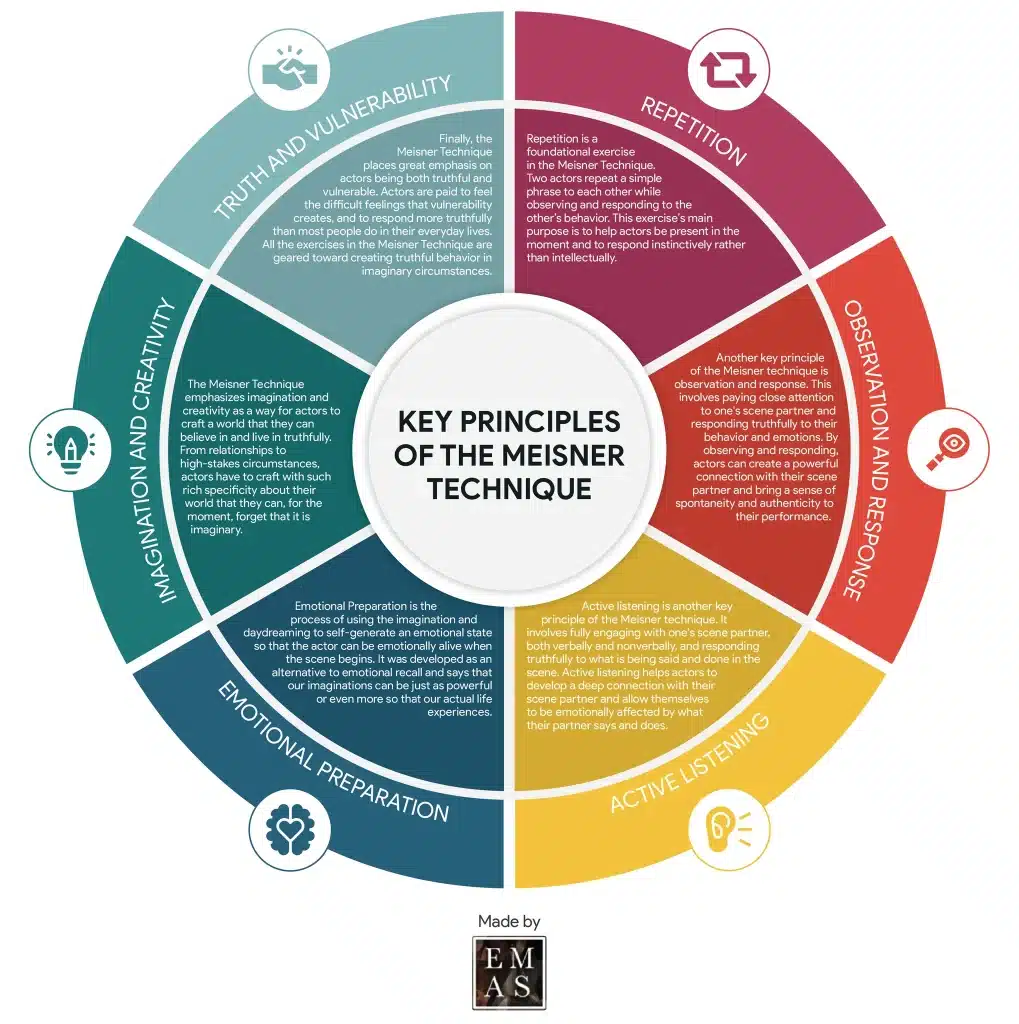
The foundational training tool of the Meisner Technique is the repetition exercise. Two actors sit facing each other and begin repeating a simple observation back and forth (“You’re smiling” / “I’m smiling”). This exercise, seemingly simple, trains deep listening, eliminates premeditated behavior, and anchors the actor in the present moment. As training progresses, the exercise is enriched with imaginary circumstances, independent activities, and emotional impulses.
For example, as actors grow more comfortable, they might introduce variations in their observations that evoke different emotional responses, or incorporate physical movements that reflect their character’s inner thoughts.
This freedom to explore allows them to discover new dimensions in their characters and connect with their scene partners on a deeper level. Additionally, the repetition exercise can be adapted to include external distractions, further challenging actors to maintain focus and presence, which is crucial for success in both theater and film.
Another central concept is emotional preparation, which Meisner distinguishes sharply from Strasberg’s emotional memory.
The actor prepares before entering the scene, using imagination to reach the emotional state required by the first line, but once on stage must completely abandon the preparation and let the partner’s behavior guide the performance.
This approach allows actors to tap into a reservoir of emotions, creating a visceral response that feels organic and unforced. For instance, an actor might utilize sensory memory techniques—such as recalling a specific scent or sound—that evoke the desired emotional state without relying on past experiences.
This shift from internal preparation to external reaction is what makes the Meisner Technique especially powerful, as it cultivates an instinctual responsiveness that is vital in creating believable interactions on stage.
The Meisner Technique is particularly valued in training for film and television, where the ability to be genuinely present and reactive in front of the camera is essential. Actors such as Robert Duvall, Diane Keaton, Jeff Goldblum, and many others trained with this approach.
It is a method that requires time and consistent practice, but it develops in the actor an expressive freedom and spontaneity that are difficult to achieve through other paths. Furthermore, the technique’s focus on genuine connection allows actors to create nuanced performances that resonate with viewers, leading to a more impactful storytelling experience. In a world saturated with scripted dialogue and rehearsed actions, the Meisner Technique stands out for its emphasis on authenticity, allowing actors to forge real relationships with their scene partners that translate into powerful performances.
This focus has contributed to the technique’s popularity among modern actors who seek to convey complex emotions in a relatable manner, enhancing their roles in both dramatic and comedic contexts.
The key principles of the Meisner Technique (infographic made by Elisabeth Mestnik):
In addition to these foundational elements, the Meisner Technique promotes a collaborative spirit among actors, encouraging them to support one another in their artistic journeys. This collaboration is exemplified in group exercises where actors must rely on each other’s impulses to create a cohesive performance. The ability to trust one another not only enhances their scenes but also fosters a supportive environment for growth and learning. Many actors find that this camaraderie helps them to develop more significant emotional depth in their performances, as they allow themselves to be vulnerable and open with their peers.
As a result, the relationships formed in training are often as valuable as the skills learned, contributing to a vibrant community of artists dedicated to the craft of acting.
Moreover, the Meisner Technique encourages actors to continually challenge themselves by stepping outside of their comfort zones. This might involve tackling roles that seem vastly different from their own personalities or experimenting with styles and genres they haven’t previously explored. By pushing these boundaries, actors not only expand their range but also discover new facets of their craft that they may not have previously considered. For example, an actor known for dramatic roles might take on a comedic character, utilizing the principles of the Meisner Technique to navigate the new demands of timing and spontaneity required in comedy.
This willingness to take risks in their performances is a hallmark of actors trained in the Meisner Technique, who often emerge with a broader toolkit to draw from in their careers.