
Choosing an acting class for kids feels like it should be straightforward.
You search online, find a program near your house, check the schedule, and sign up. But if you’ve spent more than ten minutes looking, you’ve probably discovered that it’s not that simple. Prices range from free community workshops to multi-thousand-dollar conservatory programs. Some classes promise to turn your seven-year-old into the next Hollywood star. Others seem like glorified babysitting with costumes.
And the information available to parents is almost always written by the schools themselves — which makes it hard to know what’s marketing and what’s actually good for your child.
I’ve spent over 15 years inside the theater world as an actor, producer, and consultant, and I’ve seen the full spectrum: brilliant programs that genuinely transform kids, and careless ones that waste families’ time and money. The difference is rarely obvious from a website. It shows up in the classroom, in how the teacher handles a shy child on day one, in whether the curriculum builds real skills or just fills time until the end-of-term showcase.
This article gives you the complete picture.
By the end, you’ll know what kids actually learn in a good acting class, what age to start, how to spot red flags, what to expect on the first day, and how to tell the difference between a program that develops your child and one that just entertains them.
In 30 seconds:
- The best acting classes for kids build confidence, listening skills, and empathy — not mini-celebrities.
- Age-appropriate structure and the teacher’s ability to work with children matter more than any method or technique name.
- Red flags include pushing kids toward auditions before building foundational skills and programs with no clear curriculum.
Key takeaways:
- Skills over stardom: Good programs prioritize confidence, collaboration, and creativity — not producing child prodigies.
- Teacher fit matters most: A great adult acting coach is not automatically a great kids’ instructor. Look for people who understand child development.
- Watch for red flags: Classes that push auditions or agents before building foundational skills, and programs with no structured curriculum, should raise concerns.
- Segmentation is a sign of quality: Good programs group students by age and experience level, not lump everyone together.
- The benefits go far beyond the stage: Listening, empathy, public speaking, and emotional regulation transfer to every area of your child’s life.
Quick definitions:
- Scene study: Working on scripted scenes with a partner to practice acting fundamentals like listening, reacting, and making choices.
- Improvisation (improv): Creating scenes, dialogue, and characters on the spot without a script — builds spontaneity and confidence.
- Ensemble work: Exercises and performances where the group works as a team rather than featuring individual stars.
- Devised theater: Creating original performances collaboratively, often from the group’s own ideas rather than existing scripts.
- Cold reading: Performing a script with little or no preparation, a skill commonly developed in more advanced classes.
What Do Kids Actually Learn in an Acting Class?
This is the question most parents start with, and the answer might surprise you. The most valuable things a child learns in a good acting class have very little to do with performing on a stage.
At its core, acting is the art of listening, reacting, and communicating truthfully. When a child works on a scene with a partner, they’re not just memorizing lines. They’re learning to pay attention to another person, to read body language, to respond in the moment instead of retreating into their own head. These are the same skills that make someone a good friend, a confident public speaker, and an empathetic human being.
A well-structured kids’ acting class typically covers several foundational areas:
- vocal projection and clarity (speaking so a room full of people can hear you and understand you),
- physical awareness and expression (using your body to communicate, not just your words),
- creative collaboration (building something together as a team, not competing for the spotlight),
- emotional literacy (understanding and expressing a range of emotions in a safe context),
- and imaginative thinking (creating worlds, characters, and stories from scratch).
Think about Chris Colfer. Before he became Kurt Hummel on Glee, he was a shy, introverted kid in Clovis, California, who didn’t fit in at a school dominated by sports. His parents enrolled him in a performing arts program. The first time he stepped on stage, his voice shook. But line by line, something changed. Each rehearsal stripped away a layer of self-doubt and revealed a confident young person underneath. His story isn’t unusual — it’s the pattern. Acting class didn’t just teach Colfer how to perform. It taught him who he was.
What Age Should Kids Start Acting Classes?
There’s no universal right age, but there are developmental milestones that matter more than the number on the birthday cake.
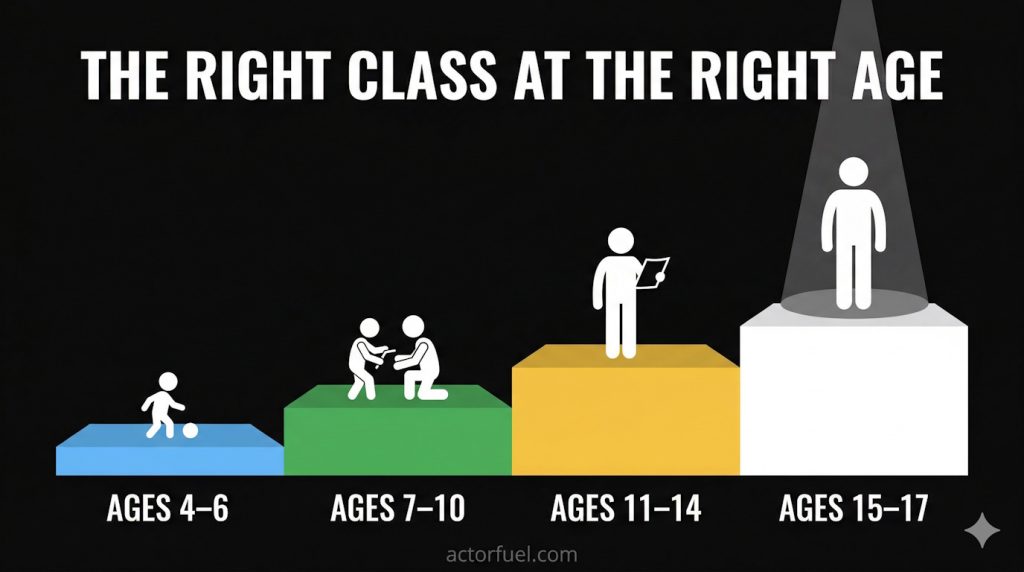
Ages 4–6: Creative Play and Exploration
At this age, children aren’t ready for “acting technique.”
They’re ready for structured creative play: storytelling games, pretend scenarios, movement exercises, and simple group performances. The goal is pure joy and self-expression. Programs for this age group should feel like play with a purpose, not training with expectations. Small class sizes (eight to ten kids maximum) and experienced early-childhood instructors are essential. If a program for four-year-olds advertises “professional training,” that’s a red flag, not a feature.
Ages 7–10: Foundation Building
This is where real skill development begins.
Children at this age can follow structured exercises, work with partners, understand basic concepts like “listening” and “reacting,” and handle the emotional complexity of simple scenes. Good programs introduce improvisation, basic scene study, ensemble work, and short performances. The focus should still be on process over product — what they learn in class matters more than how polished the end-of-term show looks.
Ages 11–14: Deepening the Craft
Pre-teens and young teenagers can handle more rigorous training:
- longer scenes,
- character development,
- basic script analysis,
- and introduction to different acting approaches.
This is also the age where some kids start to show genuine passion and aptitude. Programs should offer more challenge and specificity while remaining supportive and age-appropriate. Classes that mix eleven-year-olds with seventeen-year-olds are a warning sign — the developmental gap is enormous.
Ages 15–17: Pre-Professional Options
Teenagers who are serious about acting can benefit from programs that introduce adult-level concepts:
- in-depth scene study,
- audition technique,
- on-camera work,
- monologue preparation,
- and college audition coaching.
At this stage, class size, teacher credentials, and the rigor of the curriculum matter significantly. Some teens thrive in intensive summer programs or conservatory-style training. Others do best in weekly classes that balance depth with the realities of school life.
How to Choose the Right Acting Class for Kids
Choosing well requires looking past the website and asking the right questions. Here’s what separates a good program from a great one.
Look for Age-Appropriate Grouping
A program that puts a six-year-old and a fourteen-year-old in the same class is not taking child development seriously.
Good schools segment by age and, ideally, by experience level too. A complete beginner and a kid with three years of training need different things, even if they’re the same age. The best programs recognize this and structure their offerings accordingly. This kind of thoughtful segmentation is one of the clearest signals that a school understands its students.
Evaluate the Teacher, Not Just the School
The teacher is everything in a kids’ acting class.
A brilliant professional actor who has never worked with children may be a terrible kids’ instructor. Look for teachers who combine performing arts experience with a genuine understanding of child development. Ask: how do they handle a child who freezes on stage? How do they manage a disruptive student without shaming them? How do they ensure quiet kids get as much attention as loud ones? The answers to these questions reveal more than any resume.
Observe a Class Before Committing
Any reputable program will let you audit or observe a class.
Watch how the teacher interacts with students. Is the energy supportive or pressured? Are all kids engaged, or are some sitting on the sidelines while the confident ones dominate? Is there a clear structure, or does the class feel improvised (and not in the good way)? Pay attention to the quiet kids in the room — how the teacher includes them tells you everything about the program’s values.
Ask About the Curriculum
A good kids’ program has a structured curriculum, not just a collection of games the teacher picks on the day.
Ask what skills are taught each term, how the program progresses from term to term, and what the learning objectives are. Phrases like “we follow the kids’ energy” or “every class is different” can sound flexible, but often mean there’s no real plan. Structure gives kids safety and consistency — and it’s what produces measurable growth.
Red Flags Every Parent Should Watch For
Not every program with a nice website and enthusiastic testimonials is a good fit for your child. Here are the warning signs that experienced families know to look for.
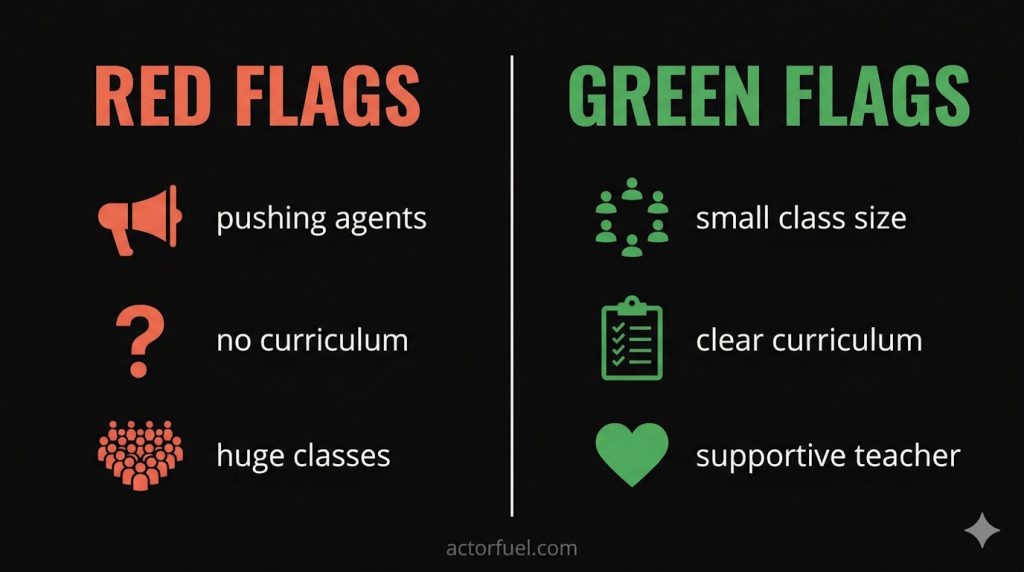
Pushing Auditions and Agents Too Early
If a kids’ program talks about headshots, agents, and auditions in the first term, be cautious.
Building foundational skills — listening, imagination, confidence, ensemble awareness — takes time. Programs that fast-track kids into the “industry” before they’ve built a foundation are often more interested in their own reputation (or their referral fees from talent agencies) than in your child’s development. Professional opportunities can come later if the child wants them. The foundation comes first, always.
No Clear Curriculum or Progression
If you ask “What will my child learn this term?” and the answer is vague, that’s a problem.
A program without a structured curriculum is running on the teacher’s mood, not on educational design. Good schools can tell you exactly what skills each level covers, how students progress from one level to the next, and what readiness looks like at each stage.
Huge Class Sizes
Any class with more than 15 kids per teacher is a crowd-management exercise, not a learning environment.
In acting, kids need personal feedback, individual attention, and the chance to be on their feet working — not sitting and watching. Twelve or fewer students per class is ideal. For younger children (ages 4–7), eight to ten is even better.
Showcase-Obsessed Programs
End-of-term showcases are wonderful when they serve the learning process.
They become problematic when the entire term is structured around preparing a performance that makes the school look good, rather than developing the individual students. If rehearsals for the “big show” eat up class time that should be spent on skill-building exercises, the program is prioritizing product over process. Your child is not there to be in a show. They’re there to grow as a person.
A Teacher Who Can’t Handle Shyness
This is the ultimate litmus test. Watch how the program handles a shy or reluctant child.
A great teacher meets that child where they are, creates safety, and never forces participation through pressure or public attention. A drama teacher named Maggie once shared a story that captures this perfectly. She had a student — a little girl so reserved she could barely whisper the other kids’ names during the opening game. The girl burst into tears one session, saying she never wanted to come back. The teacher didn’t push. She stayed patient. On the final day, the girl said she wanted to perform her monologue.
But when her turn came, she froze. The teacher asked: “Would it help if your mom came up with you?” The girl nodded. Then the teacher invited the entire class to stand behind her. The girl recited her monologue in barely a whisper, with the whole ensemble at her back. Every parent in the room was in tears. It didn’t matter that it was quiet. It mattered that she did it.
That’s the kind of teaching that transforms children.
Acting Class for Kids: Online vs. In-Person
Online acting classes became widespread during the pandemic, and many programs kept them going. They can work well for certain situations, but they come with real limitations, especially for younger children.
In-person is almost always better for kids under 12.
Acting is a physical, spatial, ensemble experience. Children learn by moving, by feeling the energy of the room, by making eye contact with a partner who is three feet away instead of a thumbnail on a screen. The social skills, the body awareness, the group dynamics — these are hard to replicate through a webcam. For younger kids especially, screen fatigue is real, and maintaining engagement over Zoom requires a very different (and often less effective) teaching approach.
Online can work well for teens (13+) in specific situations
When there’s no quality local program available, for supplementary training between in-person sessions, for audition coaching and monologue work (which are inherently more individual), or for specialized workshops with instructors the child couldn’t access locally. Some teens thrive in online environments because the intimacy of the camera reduces the intimidation of performing in front of a live group.
If you’re considering an online class, check class size (it should be even smaller than in-person — eight students maximum), camera-on requirements (a class where kids can turn their cameras off is a class where they’re not really present), and whether the teacher has specific training in online instruction, which is genuinely a different skill from teaching in a room.
What to Expect in Your Child’s First Class
First-day anxiety is real — for kids and for parents. Here’s what a well-run first class typically looks like, so you both know what to expect.
The warm-up (10–15 minutes).
The class will begin with physical and vocal warm-ups — stretching, breathing exercises, tongue twisters, and energy-building games. These serve a dual purpose: they prepare the body for creative work, and they break the ice. Good teachers use name games and simple collaborative exercises that immediately make everyone feel included, without putting anyone on the spot.
Group work and games (20–30 minutes).
The bulk of a first class is usually ensemble-based: improvisation games, storytelling circles, movement exercises, or simple scene-building activities. The goal is participation, not performance. Your child won’t be asked to stand alone in front of the group and “do something.” They’ll be working alongside their peers in a low-pressure, high-energy environment.
Cool-down and reflection (5–10 minutes).
A good class ends with a brief reflection: what did we do today? What was fun? What was hard? This teaches kids to process their creative experience rather than just consuming it, and it gives the teacher valuable feedback about each student’s comfort level and engagement.
What your child might feel afterward
- Energized and excited, tired (creative work is genuinely exhausting for kids),
- unusually talkative about what happened,
- or quiet and processing.
All of these are normal. What to watch for over the first three to five sessions:
- does your child want to go back?
- Are they mentioning classmates’ names?
- Are they re-creating games or exercises at home?
These are the signs that the class is working.
The Life Skills Behind the Spotlight
I’ve seen this pattern dozens of times in the theater world.
A child who in real life can’t hold an adult’s gaze, who answers questions in monosyllables, who stands at the edge of every group — the moment you give that child a role, a character, an imaginary costume, something shifts. They’re not themselves anymore. They’re the firefighter, the queen, the robot. And in that freedom of not being themselves, they start to find themselves. The shy voice gets louder. The rigid body loosens. The eyes come alive.
Playing someone else gives them permission to be more fully who they are.
This isn’t an accident. It’s the mechanism through which acting class develops real, transferable life skills. And the research backs it up. Studies consistently show that children who participate in drama programs develop stronger verbal and nonverbal communication skills, higher emotional intelligence, greater empathy and perspective-taking ability, improved confidence in public speaking and social situations, better collaborative and problem-solving skills, and increased resilience in the face of setbacks.
These aren’t “nice-to-haves.”
They’re foundational skills for school, for friendships, for future careers, and for life. The child who learns to project their voice in a theater exercise is the teenager who speaks up in class. The child who learns to listen to a scene partner is the adult who communicates well in relationships. The child who performs a monologue despite shaking hands is the professional who handles high-pressure presentations with composure.
Acting class isn’t about turning your child into an actor. It’s about giving them tools that make them more confident, more expressive, and more connected to the people around them — whether they ever step on a stage again or not.
FAQ
Q: At what age can a child start acting classes?
A: Most programs accept children from age 4 or 5. At this age, classes focus on creative play, storytelling games, and movement — not acting technique. Structured skill-building typically begins around age 7–8, when children can follow instructions, work with partners, and handle short scenes. The right starting age depends more on your child’s readiness for group activities than on a specific number.
Q: Are acting classes good for shy kids?
A: Often, they’re the best possible activity for shy kids. Acting provides a structured, safe environment where children can express themselves through characters rather than as themselves, which removes much of the social pressure. Good teachers never force participation and allow shy children to engage at their own pace. Many drama teachers report that their most reserved students often make the biggest leaps in confidence over time.
Q: How much do acting classes for kids cost?
A: Costs vary widely by location and program type. Community and recreational programs typically range from $100–$200 per term. Specialized studio programs run $200–$500 per month. Intensive conservatory-style programs can be $1,000 or more per term. Price doesn’t always correlate with quality. A well-run community program with a great teacher can be more valuable than an expensive studio with large class sizes and a vague curriculum.
Q: Should my child do acting classes or drama camp?
A: Both have value, but they serve different purposes. Weekly acting classes build skills gradually over months, developing discipline and consistency. Drama camps offer immersive, intensive experiences — typically one or two weeks — that build camaraderie and result in a performance. For a child who has never tried acting, a camp can be a low-commitment way to test the waters. For ongoing development, regular weekly classes are more effective.
Q: How do I know if my child’s acting class is good?
A: Watch for these signs: your child mentions classmates’ names and talks about class activities at home; the teacher gives specific, encouraging feedback (not just “great job!”); class time is spent doing exercises and scenes, not sitting and watching; the teacher handles shy or disruptive children with patience and skill; and there’s a clear curriculum that you can ask about. If your child consistently doesn’t want to go, have a conversation — it may be the class, not the activity.
Q: Do kids need prior experience to join an acting class?
A: No. Beginner classes are designed for children with zero experience. A good program will place your child at the appropriate level based on age and experience, not throw everyone together regardless of background. If a school doesn’t ask about your child’s experience level before enrolling them, that’s a signal they may not be segmenting their classes thoughtfully.
Sources
Drama Notebook — “Teaching Drama to Shy Children” (the “Maggie” story) — A drama teacher’s firsthand account of working with a reserved child over the course of an after-school program.
Theatretrain — “From Timid to Triumphant: The Power of Performing Arts in Transforming Introverted Kids” — Chris Colfer’s transformation from shy child to television star through performing arts.
Edutopia — “Implementing Story-Acting with Young Learners” – research-based approach to using drama and storytelling in early education.