
A few months ago, I performed in a musical at the Teatro Brancaccio in Rome.
We’d driven six hours through the night from Milan, rigged the set on arrival, and stepped on stage with zero sleep. The show was a disaster. Dancers missed steps they’d nailed hundreds of times. Singers lost their voices. I blanked on lines I could recite in my sleep. That night taught me something I’ll never forget: talent means nothing if your body can’t keep up.
Most articles about acting exercises for beginners give you a list of improv games and call it a day.
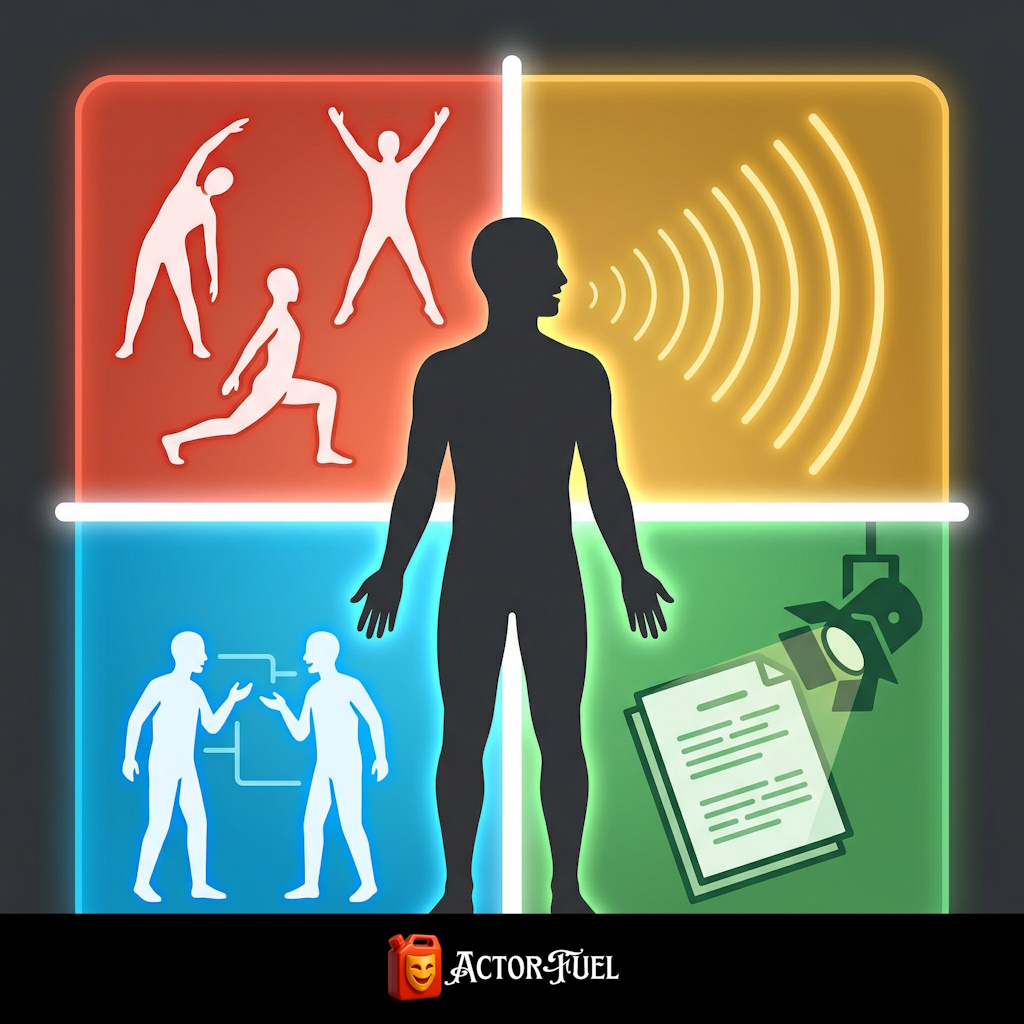
That’s only a quarter of the picture. Your body is your instrument. Your voice is your tool. Your imagination is your fuel. And if you only train one of those things, you’re building a performance on a foundation with three missing walls. The actors who show up consistently—night after night, take after take—are the ones who train their entire instrument, not just the parts that feel like “acting.”
This article gives you 15 specific exercises organized into four categories: physical, vocal, improvisation, and scene work. Every exercise can be practiced alone or with a partner, with no special equipment, in 20 minutes or less. By the end, you’ll have a daily practice routine you can start today—and a journaling method that will help you discover which exercises work best for your unique instrument.
In 30 seconds:
- Your body is your instrument—physical and vocal exercises are not optional extras, they are the foundation of reliable performance.
- Improvisation builds skills that script work alone cannot: spontaneity, listening, and truthful response in the moment.
- Consistency beats intensity—20 minutes of daily practice builds more skill than a three-hour session once a month.
Key takeaways:
- Body first: Physical warm-ups and conditioning are the foundation—everything else depends on a body that is alert, mobile, and grounded.
- Voice is trainable: Vocal exercises protect your voice from strain and build the projection, clarity, and emotional range that separate beginners from trained performers.
- Improv builds instincts: Improvisation exercises develop spontaneity, listening, and the ability to respond truthfully—skills that script work alone cannot build.
- Scene work connects everything: Script analysis and scene study exercises are where isolated technique skills become integrated performance.
- Track what works for YOU: A simple exercise journal—noting how you feel after each session—reveals which exercises are most effective for your specific instrument.
Quick definitions:
- Warm-up: A structured physical and vocal routine performed before rehearsal or performance to prepare the body, prevent injury, and focus the mind.
- Cool-down: A post-performance routine that helps the body and mind transition from the heightened state of performing back to rest.
- Diaphragmatic breathing: Breathing that engages the diaphragm muscle rather than the chest, producing deeper, more controlled breath—the foundation of vocal power and nervous system regulation.
- Resonance: The amplification and enrichment of vocal sound through the body’s natural resonating chambers (chest, throat, mouth, nasal passages, skull).
- Given circumstances: Everything the script tells you about the world of the scene—time, place, relationships, events before the scene begins. A Stanislavski concept used in script analysis.
Why Exercises Matter More Than Talent
This section explains why raw talent without trained habits will always lose to moderate talent with a consistent practice routine.
Acting is one of the few art forms where the artist’s body IS the instrument. A pianist maintains their piano. A painter maintains their brushes. But actors are expected to show up and perform with whatever condition their body and voice happen to be in that day. When the instrument is neglected—when the body is stiff, the voice is strained, the breath is shallow, the mind is scattered—no amount of talent compensates.
The performance suffers, and the actor often doesn’t understand why.
Acting exercises for beginners are not academic homework. They are the equivalent of a musician’s scales, a dancer’s barre work, an athlete’s conditioning drills. They build the physical, vocal, and imaginative capacity that allows talent to express itself reliably, under pressure, night after night. The actors who train their instrument daily don’t just perform better. They perform better consistently.
And in a profession where reliability is one of the most valued qualities, consistency is the competitive edge that talent alone cannot provide.
Physical Exercises: Preparing Your Body to Perform

In this section you’ll learn four exercises that wake up your body, release tension, and build the physical readiness every actor needs before stepping on stage or in front of a camera.
1. The full-body roll-down
Stand with feet hip-width apart.
Starting from the top of your head, slowly roll your spine forward, letting your head lead, then your neck, shoulders, upper back, and lower back, until your hands are hanging toward the floor. Let your arms dangle. Breathe deeply into your lower back. Hold for 10 seconds. Then reverse the movement, rebuilding your spine one vertebra at a time from the base up. When you reach the top, roll your shoulders back and lift your chin.
This exercise releases spinal tension, identifies areas of tightness, and resets your posture—all in under two minutes.
2. Hip circles and thoracic rotations
Place your hands on your hips and make slow, wide circles with your pelvis—10 in each direction.
Then, with feet planted and arms extended at shoulder height, rotate your upper body slowly to the left, then to the right, keeping your hips facing forward. Repeat 10 times each side. Actors carry enormous tension in their hips and thoracic spine (the mid-back region), especially after long hours sitting in rehearsal.
These two movements restore the mobility that allows your body to express emotion freely on stage.
3. The jaw release
Place the heels of your palms on your cheekbones and gently press downward while letting your jaw drop open.
Hold for 10 seconds.
Then massage the hinge of your jaw (just in front of your ears) with small circular motions for 30 seconds. Actors who clench during stressful scenes—often without realizing it—develop jaw tension that restricts vocal resonance, causes headaches, and makes facial expression stiff.
This exercise takes 60 seconds and should be done before every vocal warm-up.
4. The grounding stance
Stand with feet hip-width apart.
Press your feet into the floor as if growing roots. Roll your shoulders back and down. Lift your sternum slightly. Let your arms hang relaxed, palms forward. Lift your chin so your gaze is level with the horizon. Hold for 60 seconds while breathing slowly and deeply. This is not just a posture exercise—it is a nervous system reset. Research from performance psychology shows that expansive, upright postures reduce stress hormones and increase confidence signals within minutes.
Use this before every audition, every rehearsal, every performance.
Vocal Exercises: Protecting and Powering Your Voice
Here you’ll learn four exercises that build vocal strength, protect against strain, and develop the resonance and clarity that make your voice carry.
5. Diaphragmatic breathing (the foundation)
Place one hand on your chest and the other on your belly.
Breathe in slowly through your nose for a count of four. Your belly hand should rise; your chest hand should barely move. Exhale slowly through your mouth for a count of six, letting your belly draw inward. Repeat for 2 minutes. This is the single most important vocal exercise any actor can learn. Diaphragmatic breathing is the foundation of projection, vocal power, and nervous system control. Actors who breathe from their chest run out of air mid-sentence, strain their throat, and trigger anxiety responses.
Actors who breathe from their diaphragm have steady, supported voices that can fill a theater without effort.
6. Lip trills and humming
Blow air through closed, relaxed lips to create a motorboat-like vibration (a lip trill).
Sustain the trill while sliding your pitch from low to high and back down. Do this for 60 seconds. Then close your lips and hum on a comfortable note, feeling the vibration in your chest, throat, and face. Slide the hum up and down your range for another 60 seconds. Lip trills warm up the vocal folds gently without strain. Humming activates your resonators—the chambers in your body that amplify and enrich your sound.
Together, these two exercises prepare your voice for performance in under three minutes.
7. Articulation drills
Repeat the following consonant combinations slowly, then increase speed: “pta-ptah-ptah,” “bda-bdah-bdah,” “kga-kgah-kgah.”
Then move to tongue twisters: “Red leather, yellow leather” and “Unique New York” are classics. Spend 2 minutes on this. Articulation drills train the muscles of your lips, tongue, and jaw to produce clear, precise speech. In a theater, unclear diction means the audience misses your words. On camera, mumbled dialogue means another take.
Clean articulation is a trainable skill, not a natural gift.
8. The resonance expander
Hum on a comfortable note and gradually open your mouth from the hum into an “ahh” vowel, feeling the sound shift from your nose and chest into the open space of your mouth.
Then try directing the hum into different resonators: press your fingers to your chest and feel the vibration (chest voice), touch the bridge of your nose (head voice), place your hand on the top of your skull (falsetto range). Spend 2 minutes exploring where your voice resonates most fully at different pitches.
This builds awareness of your vocal instrument and develops the richness that separates a trained voice from an untrained one.
Want the full physical performance system? The V.I.G.O.R. Method is a free 5-day email course covering Vitals, Intake, Grit, Oxygen, and Reset—everything your body needs to show up at its best, every time. Click here to get it for free
Improvisation Exercises: Training Spontaneity and Listening
In this section you’ll learn four exercises that build the instincts, listening skills, and creative responsiveness that script work alone cannot develop.
9. “Yes, and…” (the foundation of improv)
With a partner, start a scene with a simple suggestion (a location, a relationship, an activity).
Every response must accept what the other person established (“Yes”) and add new information (“and…”). If your partner says “We’re on a sinking ship,” you don’t say “No, we’re in a restaurant.” You say “Yes, and the lifeboat only fits one of us.” This is the golden rule of improvisation.
It trains you to listen, accept, build, and collaborate—skills that are just as essential in scripted work as they are in improv.
10. The mirror exercise
Stand face-to-face with a partner.
One person leads by making slow, continuous movements; the other mirrors them as precisely as possible. After two minutes, switch roles. After another two minutes, try removing the designated leader entirely—both partners move simultaneously, following and leading at the same time. Developed by Viola Spolin, this exercise builds presence, connection, and the ability to respond to subtle physical cues from your scene partner.
It trains the skill Sanford Meisner valued most: paying attention to the other person instead of monitoring yourself.
11. Gibberish storytelling
Tell a partner a story using only nonsense syllables—no real words.
Communicate the narrative entirely through your vocal inflection, facial expressions, body language, and emotional commitment. Your partner listens and then retells the story they understood in English. This exercise, also from Viola Spolin, forces you to communicate with your entire instrument rather than relying on words.
It builds expressiveness, physical storytelling, and the understanding that communication is far more than dialogue.
12. The one-word story
Stand in a circle with three or more people.
Build a story together, with each person contributing only one word at a time, going around the circle. The story must have a beginning, middle, and end. This exercise trains active listening (you must hear every word to contribute the right one), collaborative thinking, and the ability to release control—three skills that every actor needs in ensemble work and scene study.
Scene Work Exercises: Connecting Craft to Performance
Here you’ll learn three exercises that connect your physical, vocal, and improvisational skills to the work of inhabiting a character and performing a scene.
13. Given circumstances exploration
Choose a simple script scene or monologue.
Before performing it, write down everything the text tells you about the character’s world: where are they, when is it, who are they talking to, what just happened before the scene begins, what do they want, and what is stopping them from getting it. Then perform the piece twice: once with a neutral reading, and once with your given circumstances fully active. The difference will be immediately apparent.
This exercise, rooted in Stanislavski’s system, teaches you that great performance is built on specific knowledge of the character’s world—not on vague emotion.
14. The objective exercise
Take a simple two-person scene and assign each actor a clear, active objective: not a feeling (“I want to feel sad”) but an action (“I want to convince you to stay” or “I want to make you admit you were wrong”).
Perform the scene while pursuing your objective with full commitment, regardless of whether you “succeed.” The energy and specificity this creates is the engine of compelling dramatic performance. When actors have clear objectives, scenes come alive.
When they don’t, scenes drift.
15. The speed run
Take a scene you’ve prepared and perform it at normal pace.
Then perform it again at double speed—same words, same blocking, same emotional arc, but twice as fast. Then a third time, twice as fast again. This exercise, simple as it sounds, reveals where you’re thinking instead of doing, where your choices are not yet instinctive, and where the energy of the scene needs to be higher.
It also builds stamina and forces you to trust your preparation instead of deliberating in the moment.
Building Your Daily Practice: A 20-Minute Routine
This section gives you a structured daily routine you can start tomorrow—and the journaling method that will customize it to your instrument over time.
The biggest barrier to consistent practice is overwhelm. Fifteen exercises feels like a lot. But you don’t need to do all of them every day. Here is a 20-minute daily routine that rotates through the four categories and keeps your instrument in shape with minimal time commitment.
The daily 20 (pick one focus per day, cycle through the week):
- Monday — Body day (10 min): Full-body roll-down, hip circles, thoracic rotations, jaw release, grounding stance. Then 10 minutes of a physical practice that works for you—yoga, stretching, even a walk.
- Tuesday — Voice day (10 min): Diaphragmatic breathing (2 min), lip trills and humming (3 min), articulation drills (2 min), resonance expander (3 min). Then 10 minutes of reading aloud from any text, focusing on clarity and breath support.
- Wednesday — Improv day (20 min): “Yes, and…” with a partner (or solo gibberish storytelling if alone), mirror exercise, one-word story. If solo, practice gibberish monologues and character walks.
- Thursday — Scene day (20 min): Given circumstances exploration on a new monologue or scene, objective exercise with a partner, or speed run on material you’re currently working on.
- Friday — Free choice (20 min): Whatever felt most useful this week. Double down on the category where you noticed the most growth or the most resistance.
The exercise journal: the most powerful tool nobody talks about
Here is the single most important health habit I’ve discovered as a performer, and it has nothing to do with any specific exercise.
It’s keeping a journal. A simple notebook where, after every practice session, you write two things: what you did and how you felt afterward. Not a detailed essay—two or three sentences. “Did hip circles and grounding stance. Felt noticeably calmer and more centered.” “Did diaphragmatic breathing and articulation. Voice felt warmer and more open in rehearsal.” “Tried Qi Gong for the first time. Felt silly doing it. Brain was sharper afterward.”
I discovered this the hard way.
For years, I dismissed certain types of exercises because they didn’t “feel like acting.”
Qi Gong, for instance—slow, meditative movement that looked nothing like the high-energy physical work I associated with performer training. I snobbered it for years. Then, during a particularly demanding production period, a colleague convinced me to try a 15-minute Qi Gong routine after a long rehearsal day. I wrote in my journal that night: “Mental clarity noticeably better. Body felt released in a way stretching never achieves.” I tried it again the next day. Same result.
Within a month, Qi Gong had become one of my most reliable tools for mental clarity and physical recovery—something I never would have discovered if I hadn’t tracked the results.
The journal does something no exercise list can do: it tells you which exercises are most effective for YOUR specific instrument. Every body is different. Every voice is different. Every nervous system responds differently to different stimuli. The exercises in this article are a starting menu. Your journal will turn that menu into a personalized training system. Over weeks and months, patterns will emerge: which warm-ups leave you feeling most ready to perform, which vocal exercises give you the most resonance, which improv games sharpen your instincts fastest.
That personalized knowledge is worth more than any generic exercise list—and it’s available to anyone willing to write three sentences after every practice session.
FAQ
Q: Can I practice acting exercises alone?
A: Yes. Most physical, vocal, and scene work exercises can be done solo. Some improv exercises require a partner, but gibberish storytelling, character walks, and given circumstances exploration all work as solo practice. Even the mirror exercise can be adapted by working in front of an actual mirror.
Q: How often should beginners practice acting exercises?
A: Daily practice of 15–20 minutes is far more effective than occasional long sessions. Consistency builds the neural pathways and muscle memory that make skills automatic under pressure. If 20 minutes is not possible, even 10 minutes of vocal and physical warm-ups makes a measurable difference.
Q: What is the best warm-up before an acting class?
A: A full-body roll-down, hip circles, jaw release, and two minutes of diaphragmatic breathing is a complete pre-class warm-up that takes under five minutes. Add lip trills and a short articulation drill if you have more time. The goal is to arrive physically alert, vocally ready, and mentally present.
Q: Do acting exercises actually improve your performance?
A: Yes. Research in performance science shows that deliberate practice of specific skills leads to measurable improvement in motor control, vocal production, creative fluency, and stress management. The key word is “deliberate”—exercises done with focus and intention produce results. Exercises done mechanically while scrolling your phone do not.
Q: What exercises do professional actors use?
A: Most professional actors maintain a daily warm-up routine that includes physical stretching or movement, vocal exercises (breath support, resonance, articulation), and some form of scene study or monologue work. Many also practice meditation, yoga, Pilates, or other body-mind disciplines. The specific exercises vary, but the principle of daily instrument maintenance is universal among working professionals.
Q: Are improv exercises useful for non-improv actors?
A: Absolutely. Improvisation develops listening, presence, spontaneity, and collaborative instincts that are essential in all forms of acting—scripted theater, film, television, and commercial work. Many of the greatest acting teachers, including Viola Spolin and Sanford Meisner, built their training systems around improvisational exercises specifically because these skills transfer so powerfully to scripted performance.
Sources
Backstage — “8 Acting Exercises for the Well-Prepared Performer” — exercises drawn from Stanislavski, Meisner, Uta Hagen, and Spolin with practical application guidance.
MasterClass — “7 Acting Warmups, Games, and Techniques for Actors” — warm-up routines and ensemble exercises for actors at all levels.