
Acting for beginners adults is one of the most searched topics in the performing arts world, and for good reason.
Every year, thousands of adults decide they want to try acting for the first time. Maybe it’s a lifelong dream. Maybe it’s a career pivot. Maybe someone just told them they’d be great on stage. Whatever the reason, the first question is always the same: where do I actually start?
The problem is that most advice out there is either aimed at kids, written by acting schools trying to sell you a program, or so vague it’s useless. “Just get out there and audition!”
Great.
Audition for what?
With what skills?
The gap between “I want to act” and “I’m ready to step into a rehearsal room” feels enormous when nobody gives you a concrete roadmap.
This article is that roadmap. By the end, you’ll know exactly which five foundational skills to build first, how to practice them on your own before spending money on classes, how to choose training that actually works, and what your first 30 days should look like. No fluff. No “believe in yourself” speeches. Just practical steps from someone who’s trained and worked with actors at every level.
In 30 seconds:
- You can start acting at any age — the core skills are trainable, not inherited, and many successful actors began as adults.
- The foundation of good acting is listening and reacting truthfully, not memorizing lines or performing emotions.
- You can build real skills at home with structured solo drills before investing in formal classes.
Key takeaways:
- No age limit: The skills that make great actors are trainable at any stage of life.
- Listening is the foundation: The core of acting is learning to react truthfully, not line memorization.
- Solo practice works: You can build real acting skills at home using structured drills before spending money on classes.
- Learn multiple techniques: The best beginner training exposes you to several methods rather than locking you into one.
- Script analysis is underrated: It’s the most overlooked beginner skill, and it makes everything else easier.
Quick definitions:
- Script analysis: The process of breaking down a text to understand its structure, character relationships, and dramatic beats before rehearsing.
- Beat (acting): The smallest unit of action in a scene — the moment when the dynamic between characters shifts.
- Objective: What your character wants in a scene — the driving force behind every line and action.
- Tactics: The specific approaches a character uses to pursue their objective, moment by moment.
- Cold reading: Performing a script with little or no preparation, a common skill tested in auditions.
Is It Too Late to Start Acting for Beginners Adults?
Let’s get this out of the way immediately: no, it is not too late.
Not at 25, not at 35, not at 50. The “you had to start as a child” myth is one of the most damaging ideas in the performing arts. It keeps talented, passionate people on the sidelines for no good reason.
Acting is not gymnastics.
There’s no physical peak you’ve missed. The skills that make someone a compelling actor — the ability to listen, to empathize, to analyze a text, to make bold creative choices, to be vulnerable in front of others — are not things you age out of. In fact, adults often have a significant advantage: life experience. You’ve navigated relationships, loss, conflict, joy, failure, and ambiguity. A 20-year-old fresh out of school is borrowing emotions. You’ve lived them. That’s raw material that no amount of conservatory training can replicate.
Alan Rickman didn’t land his first major film role until he was 42. Kathryn Joosten started acting at 56 and won two Emmys. The industry has roles for every age, and audiences connect with authenticity more than youth. The question isn’t “am I too old.” The question is “am I willing to train.”
The 5 Core Skills Every Adult Beginner Should Build First
When you’re starting from zero, the sheer number of acting “techniques” and “methods” can feel paralyzing.
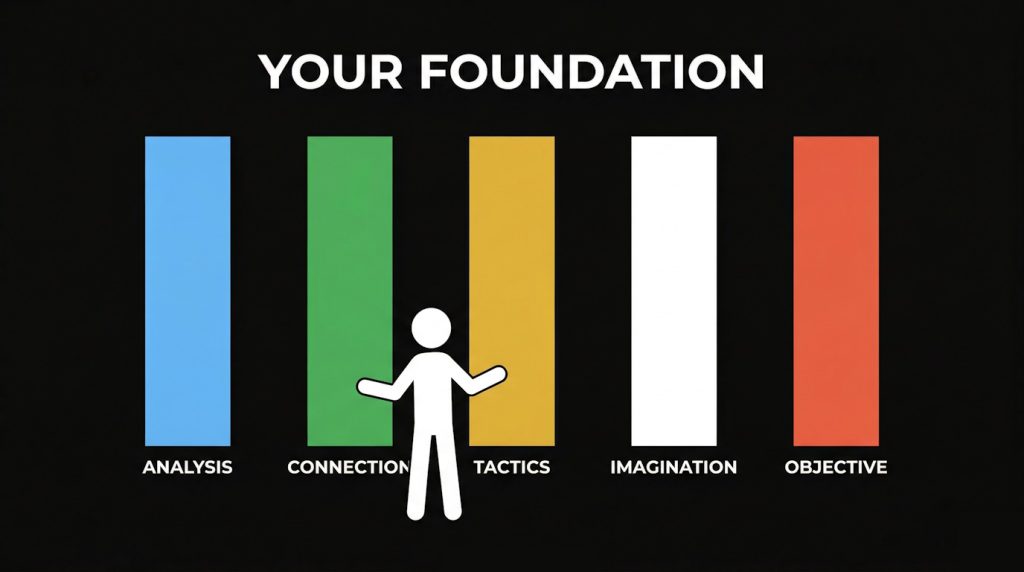
Stanislavski, Meisner, Adler, Chekhov, Hagen, Practical Aesthetics — the list goes on. Beginners often get stuck trying to figure out which one is “right” before they’ve even stepped on a stage. Don’t. You need to build five foundational skills first. The techniques are tools that help you sharpen these skills later.
1. Script Analysis
This is the skill most beginners skip, and it’s the one that makes everything else easier.
Script analysis means reading a text not as a story, but as a blueprint. You learn to identify the given circumstances (where, when, what just happened), break scenes into beats, assign active verbs to each beat, and mark the text like a musical score. When you walk into a rehearsal room owning the architecture of the scene, you make better choices, take direction faster, and feel grounded instead of lost. This is one of the foundational pillars of the A.C.T.I.O.N. Method — and it’s where every serious actor starts.
2. Listening and Connection
Here’s a truth that surprises every beginner: the audience isn’t watching you when you speak.
They’re watching you when you listen. The ability to genuinely receive what your scene partner gives you, let it affect you, and respond truthfully is what separates alive performances from dead ones. Listening is not passive. It’s the most active thing you can do on stage. You’re not waiting for your turn to talk. You’re letting the other person’s words and energy change you in real time.
3. Physical and Vocal Awareness
Your body is your instrument.
If your shoulders are permanently locked, your jaw clenched, and your breath shallow, your acting will reflect that tension regardless of how good your “inner work” is. Adult beginners need to develop awareness of how they hold tension, learn to release it, and discover the full range of their voice and physical expression. You don’t need to become a dancer or a singer. You need to make friends with your own body so it works for you instead of against you.
4. Tactical Variety
In real life, when you want something from someone, you don’t use the same approach for the whole conversation.
You charm, then plead, then challenge, then retreat. Acting works the same way. Tactics are the specific, moment-to-moment choices about how you pursue your objective. Beginners tend to find one emotional tone and ride it for an entire scene. Learning to shift tactics — to change gears within a scene — is what makes performances dynamic and watchable.
5. Imagination and Inner Life
When your character talks about a memory, you need to see it.
When they’re supposed to be freezing cold, your body needs to recall what cold feels like. Imagination is the engine that turns words on a page into lived experience. The good news: you already know how to do this. You did it instinctively as a child when you played pretend. Adult training is about reclaiming that capacity and making it precise and reliable.
Want to go deeper? The A.C.T.I.O.N. Method is a free 5-day email course that covers all five of these skills with real exercises you can practice solo, with a partner, or on self-tape. No fluff, no theory lectures. Click here and get it for free
How to Practice Acting for Beginners Adults at Home
One of the biggest myths about learning to act is that you can’t do it alone. You absolutely can — and you should, at least in the beginning. Solo practice builds the foundation that makes group classes ten times more productive. Here are four drills you can start tonight, no partner required.
The 4-Layer Script Breakdown (Solo)
Pick any scene from a play you love.
Read the entire play first to absorb the story. On your second read, grab a notebook and map out four layers: the given circumstances (time, place, what just happened), the beats (draw a slash mark every time the energy shifts), the actions (assign an active verb to each beat — “to challenge,” “to comfort,” not vague states like “sad”), and text markings (breath marks, operative words, beat-change markers). Spend 30 minutes on this. You’ll be amazed at how much clearer the scene feels from just one focused pass.
The Reaction Inventory (Solo)
Record yourself reading the other character’s lines from a scene you know.
Play it back and just listen. Don’t act. Don’t prepare a response. Notice what happens in your body: where does tension build? When does your breath change? Where do you want to interrupt, look away, or lean in? Write down what you discover. These are your truthful reactions, and they’re more interesting than anything you could plan.
The Verb Swap (Solo)
Take a short monologue and perform it three times, each time with a radically different action verb.
Deliver the same words while playing “to seduce,” then “to warn,” then “to beg.” Record yourself and watch back. You’ll be stunned by how different the same text sounds when the intention changes. This drill also builds your audition muscle: when a casting director asks you to “try it a different way,” you’ll know exactly what to do.
Inner Images (Solo)
Take a monologue where your character describes something that isn’t physically present — a memory, a place, a person.
Before performing, close your eyes and build the image in vivid detail. What does the room look like? What’s the light doing? What do you smell? Then deliver the monologue while actually seeing that image in your mind’s eye. Don’t describe it to the audience. Just see it. Your eyes will change, your body will respond, and the audience will feel the truth without you doing anything extra.
Choosing the Right Acting Class as an Adult Beginner
At some point, solo practice isn’t enough.
You need the pressure of performing in front of others, the feedback of a skilled teacher, and the chemistry of working with scene partners. Choosing the right class matters — a bad first experience can convince you that acting “isn’t for you” when the real problem was the class.
Look for classes that prioritize scene work over lecture.
You learn acting by doing, not by listening to someone talk about theory for two hours. A good beginner class should have you on your feet working scenes within the first or second session. Avoid classes that feel like group therapy. Emotional vulnerability is part of acting, but a class that pushes you to cry or share personal trauma before you’ve built basic technical skills is putting the cart before the horse.
Check the class size.
Anything over 16 students means you won’t get enough personal feedback or stage time. Twelve or fewer is ideal. Ask about the teacher’s professional experience — not just their teaching credentials, but whether they’ve actually worked as actors or directors. Theory without practice produces teachers who know what acting should look like but can’t show you how to get there.
Finally, attend a trial class or audit before committing money. Most reputable studios allow this. Pay attention to how the teacher gives feedback. Are they specific and actionable (“Play a stronger action verb in that second beat — try ‘to corner’ instead of ‘to talk to’”) or vague and unhelpful (“Just feel it more”)? Specific, technique-based feedback is what accelerates growth.
Methods and Techniques — What You Need to Know (Not Choose)
This is where I need to tell you a personal story, because it’s the single most important lesson I’ve learned about acting training.
A few years ago, I had the chance to study with two acting teachers.
Both were exceptional — genuinely gifted actors and brilliant instructors. But their approaches were polar opposites. The first was a devoted Stanislavski purist. Everything was inside-out: emotional memory, deep psychological analysis, mining your personal history to fuel the character’s inner life. His classes felt like therapy sessions with a script attached. When it clicked, it was electric — performances that felt raw and devastatingly real.
The second was a hardcore Meisner disciple.
Everything was outside-in: repetition exercises, listening, reacting truthfully to what your partner gives you, moment by moment. Forget your feelings — pay attention to theirs. When it clicked, the work felt alive, spontaneous, and completely present.
Both methods have shaped some of the greatest actors of all time.
Both have decades of proven results. But their students took sides. Hard. It became an ideological war. “Stanislavski is the only real technique.” “Meisner is the only way to be truthful.” The teachers got pulled into it too. They started competing, poaching each other’s students, booking the same theaters to one-up each other. What started as a difference in philosophy became a full-blown feud. And the people who lost the most were the students, who closed themselves off to half of what acting has to offer because they’d been taught that the other side was the enemy.
I watched all of this from the middle.
And it taught me something I carry to this day: there is no single “right” method. There is only YOUR method.
The actors who truly thrive aren’t the ones who pledge loyalty to one school. They’re the ones who study everything, test everything, keep what works for them, and build their own personal toolkit. Stanislavski’s emotional depth. Meisner’s radical listening. Adler’s imagination work. Hagen’s specificity. Chekhov’s physicality. Practical Aesthetics’ simplicity. As a beginner, your job isn’t to pick a team. It’s to learn the landscape. Taste everything. Your method will emerge from what resonates with your instrument and your instincts.
Common Mistakes Adult Beginners Make (and How to Avoid Them)
After years of working with actors at every level, I’ve seen the same beginner mistakes repeated over and over. Recognizing them early saves you months of frustration.
Memorizing Lines First
The instinct is natural: you get a script, you start memorizing.
But memorizing lines before understanding the scene is like learning a song by memorizing which piano keys to press without ever hearing the melody. You might hit the right notes, but the music won’t be there. Always analyze first, memorize last. When you understand the structure, the beats, and the actions, the lines often memorize themselves because they’re connected to meaning, not just sequence.
Performing Emotions Instead of Playing Actions
Beginners often think acting means “feeling things really hard.”
So they try to make themselves sad, or angry, or scared. The result is always the same: generalized emotional noise that reads as fake. The fix is simple but counterintuitive: stop trying to feel things and start trying to DO things. Play active verbs. “To challenge,” “to comfort,” “to dismiss.” When you commit to a specific action, the emotions arise naturally as a byproduct. You can’t play an emotion. You can play a verb.
Spending Too Much Energy on Your Own Lines
Beginner actors put 90% of their focus on what they’re about to say and 10% on what their partner is doing.
Experienced actors reverse that ratio. The truth of a scene lives in the listening, not in the delivery. If you’re mentally rehearsing your next line while your partner speaks, you’re not in the scene. You’re in your head. Train yourself to put your attention fully on the other person and trust that your response will come.
Comparing Yourself to People With Years of Training
You’re in a beginner class. Someone else seems effortlessly brilliant.
You feel terrible. What you don’t see: they’ve been doing community theater since they were 12. Or they have a theater degree they’re refreshing. Or they’re just as terrified as you and happen to be good at hiding it. Your only meaningful comparison is you today versus you last week. Progress in acting is cumulative and personal. Focus on your own instrument.
Your First 30 Days as an Adult Beginner Actor
Here’s a realistic plan for your first month. This isn’t about becoming great in 30 days. It’s about building a real foundation and figuring out your next steps.
Week 1: Read and Analyze. Pick two short plays and read them cover to cover. Not for your “potential role” — for the story. Then pick one scene and run the 4-layer script breakdown: given circumstances, beats, actions, text markings. Spend 30 minutes per session, three sessions this week.
Week 2: Listen and React. Do the Reaction Inventory drill three times with different scenes. Record the other character’s lines, play them back, and just listen. Write down what your body does. Also do the Verb Swap drill: pick a monologue and perform it three times with three different verbs. Record everything and watch back.
Week 3: Start Class Shopping. Research three to five beginner classes in your area (or reputable online options). Audit at least one. Apply the criteria from the section above: scene work focus, small class size, specific feedback, teacher with real professional experience. Don’t rush this decision — the right class will accelerate your growth dramatically, and the wrong one can set you back.
Week 4: Commit and Show Up. Enroll in the class that felt right. Start attending. Set a practice schedule: 20 minutes of solo drill work on the days you don’t have class. Begin building the habit of daily craft work, even in small doses. Consistency beats intensity every time.
FAQ
Q: Can you start acting at 30 with no experience?
A: Absolutely. Many working professional actors started training in their 30s or later. Alan Rickman’s first major film role came at 42. The skills that make great actors — listening, empathy, imagination, analytical thinking — are all trainable at any age. Your life experience is a genuine asset, not a handicap.
Q: Do I need to take acting classes or can I learn on my own?
A: You can build a real foundation on your own using solo drills like script analysis, the Reaction Inventory, and the Verb Swap. But eventually, you’ll need the pressure of performing for others and the feedback of a skilled teacher. Self-study is excellent preparation for classes, not a permanent replacement.
Q: What is the best acting technique for beginners?
A: There is no single “best” technique. The strongest actors study multiple approaches — Stanislavski, Meisner, Adler, Chekhov, Practical Aesthetics — and build their own personal toolkit from what resonates. As a beginner, look for training that exposes you to several methods rather than locking you into one school of thought.
Q: How long does it take to get good at acting?
A: With consistent training (classes plus solo practice), most beginners see meaningful improvement within three to six months. You’ll feel more confident and grounded in scenes within weeks. Becoming a truly skilled actor is a lifelong process, but the foundational skills develop faster than most people expect when the training is focused and practical.
Q: Is acting harder to learn as an adult than as a child?
A: In some ways it’s easier. Adults have emotional maturity, analytical skills, discipline, and life experience that children lack. The main challenge is self-consciousness — adults have more social inhibitions to work through. But that’s exactly what good training addresses, and most adults break through that barrier quickly in a supportive class environment.
Q: What should I prepare for my first acting class?
A: Most beginner classes require no preparation. Wear comfortable clothes you can move in. Bring a notebook and pencil for marking scripts. Leave your ego at the door and be willing to make mistakes — that’s where the learning happens. If the class requires a monologue or scene, the teacher will assign it. You won’t need a headshot or resume for a beginner class.
Sources
Stanislavski, K. – An Actor Prepares. – The foundational text on script analysis, given circumstances, and the actor’s inner process.
Meisner, S. & Longwell, D. Sanford – Meisner on Acting. – The definitive guide to the Meisner Technique and the repetition exercise.