
Let me tell you about the night I discovered that an actor’s biggest enemy on stage isn’t a missed cue or a broken prop.
It’s your own mind. I was performing in a musical at the Teatro Brancaccio in Rome—a career-defining opportunity. We’d driven six hours through the night from Milan, rigged the set on arrival, and stepped on stage with zero sleep. I knew my lines perfectly. I’d performed the material dozens of times without a single mistake. But the moment the lights hit, a voice in my head whispered: “You haven’t slept. What if you forget?” That was all it took. The thought landed like a stone in a still pond. Suddenly I wasn’t thinking about my character or my scene partner.
I was monitoring myself, scanning for the mistake that hadn’t happened yet. Within minutes, the lines vanished. My body froze. The fear of forgetting had become a self-fulfilling prophecy.
Actor mental health is not a side topic. It is a professional survival skill. The research is clear: performers experience depression, anxiety, and stress at significantly higher rates than the general population. The entertainment industry’s specific pressures—financial instability, constant rejection, emotional labor, identity confusion from deep character work—create a psychological environment unlike almost any other profession.
And most actors receive zero training in how to manage it.
This article breaks down why the acting profession is uniquely hard on mental health, identifies the specific risk factors you need to understand, and gives you practical, evidence-based tools for building psychological resilience. This is not therapy advice. It’s a field guide for performers who want to protect their minds with the same intention they bring to their craft.
In 30 seconds:
- Actors experience depression, anxiety, and stress at rates significantly higher than the general population—this is research, not anecdote.
- Performance anxiety is a trainable neurological pattern, not a character flaw—the same body chemistry that creates panic also creates peak performance.
- Building mental resilience is a professional skill that the most consistent performers train deliberately.
Key takeaways:
- Documented crisis: Actors face depression, anxiety, and substance issues at rates far exceeding the general population—a landmark study of 782 actors found a quarter had experienced debilitating performance anxiety.
- Specific risk factors: Financial instability, rejection, identity confusion from character work, emotional hangovers, and the comparison trap create a uniquely challenging psychological environment.
- Anxiety is reframeable: Performance anxiety and excitement share nearly identical physiology—the difference is how your brain labels the sensation.
- Recovery is essential: Emotional hangovers after intense roles are real and documented—actors need deliberate cool-down practices the way athletes need recovery protocols.
- Mental training compounds: Building psychological resilience is not a one-time fix but a daily practice that compounds over weeks and months into genuine, lasting stability.
Quick definitions:
- Performance anxiety: A stress response triggered by performing or anticipating performance—characterized by racing heart, shallow breathing, cognitive disruption, and heightened self-monitoring.
- Emotional hangover: The residual emotional state actors carry after performing in emotionally intense roles—difficulty “letting go” of the character’s feelings after the curtain falls.
- Character bleed: The phenomenon where the boundary between an actor’s own identity and a character’s personality becomes blurred, especially during extended runs or method-intensive work.
- Nervous system regulation: The ability to consciously shift your body from a stress state (fight-or-flight) to a calm, focused state (rest-and-digest) using techniques like breathwork and grounding.
- Cognitive reframing: A psychological technique for changing the interpretation of a situation—for example, relabeling anxiety as excitement—to shift your emotional and behavioral response.

The Numbers: Why Actor Mental Health Is a Real Crisis
This section presents the research data that confirms what most performers already sense—the profession takes a measurable psychological toll.
A landmark study conducted by the University of Sydney surveyed 782 professional actors and found that performers experience significantly higher levels of depression, anxiety, and stress compared to the general population. A quarter of the actors surveyed reported experiencing debilitating performance anxiety at some point in their career. Many reported using alcohol and drugs to cope with the emotional demands of the profession.
The study also found that over 80 percent of actors reported financial stress, 40 percent earned less than $10,000 from acting in a single year, and a quarter had experienced harassment or bullying during their work.
These findings are consistent with broader industry data.
According to the National Alliance on Mental Illness, entertainment industry workers are approximately three times more likely to struggle with mental health challenges than the general population. An Australian study of over 2,400 creative professionals found higher rates of depression, anxiety, suicidal ideation, alcohol misuse, and illicit drug use compared to the general public. A Canadian study reported similar patterns while also highlighting sleep issues and negative self-image as heightened concerns for performing artists.
The numbers paint a picture that most working actors will recognize from personal experience: this profession is genuinely, measurably harder on the mind than most careers. That doesn’t mean it’s unsustainable. But it does mean that mental health awareness and proactive self-care are not optional extras—they are professional necessities.
The 5 Risk Factors That Make Acting Uniquely Hard on the Mind
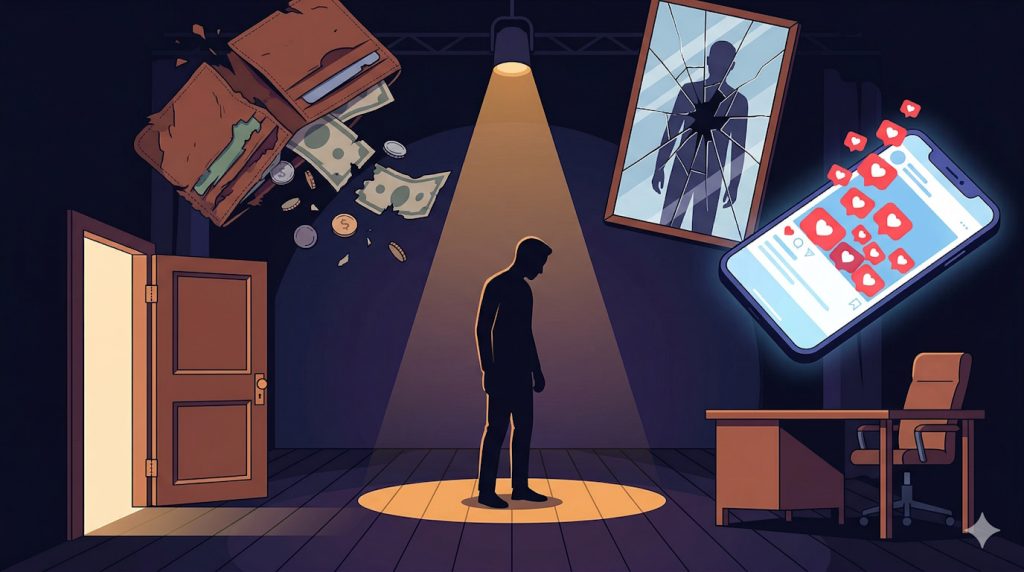
Here you’ll see the specific pressures that make acting different from other high-stress professions—and why generic mental health advice often misses the mark for performers.
1. Financial instability
Acting is one of the few professions where even highly skilled practitioners regularly face periods of zero income. The gap between jobs creates chronic financial anxiety that compounds over months and years. Unlike other precarious industries, actors cannot easily supplement their income with work in their field—when you’re not cast, you’re not working, and there is no guarantee of when the next job will come. This instability creates a background hum of stress that affects everything from sleep quality to relationship health.
2. Rejection as a daily reality
Actors face rejection at a frequency and intimacy that most professionals never experience. A casting director doesn’t reject your work—they reject YOU. Your face, your voice, your body, your presence. Even experienced actors who understand intellectually that rejection is not personal still absorb the emotional weight of being told, repeatedly, that they are not what someone is looking for. Over time, this erodes self-worth in ways that are difficult to detect until the damage is significant.
3. Identity confusion from deep character work
Actors routinely inhabit other people’s emotions, traumas, worldviews, and psychological states. Research from the Australian Actors’ Wellbeing Study found that nearly 39 percent of actors reported difficulty “relaxing or letting go” after emotionally taxing performances. Some acting methodologies—particularly those rooted in affective recall—ask performers to access genuine personal trauma as fuel for their characters. When this work is done without adequate psychological support or cool-down protocols, the boundary between self and character can become dangerously blurred.
4. The comparison trap
Social media has intensified an already vicious comparison culture in the performing arts. Actors see peers booking roles, winning awards, and posting highlights while they themselves are between jobs, struggling financially, or recovering from a difficult rejection. The comparison is constant, public, and curated to show only success. This environment breeds imposter syndrome, envy, and a distorted sense of personal failure that has nothing to do with actual talent or progress.
5. Lack of structural support
Most acting training programs include extensive instruction in voice, movement, and technique—but almost none include training in psychological resilience, nervous system regulation, or post-performance recovery. Actors are expected to access extreme emotional states on demand and then “just deal with it” after the curtain falls. The profession’s unions and organizations are slowly beginning to address mental health, but for the vast majority of working actors, psychological support remains something you either find on your own or go without.
Performance Anxiety: It’s Not a Flaw, It’s a Pattern
In this section you’ll discover why performance anxiety is not a sign of weakness—and why the same physiology that creates panic also creates peak performance.
Here is something that changed how I think about nerves forever: stage fright and excitement are physiologically almost identical. The racing heart, the shallow breathing, the buzzing energy, the heightened alertness—the body’s signature of anxiety is nearly the same as its signature of excitement. The difference is entirely in how your brain labels the sensation. When your brain says “This is dangerous,” you freeze. When your brain says “This is exciting,” you perform. Same adrenaline. Same cortisol.
Completely different outcome.
This insight, drawn from performance psychology—the same science that trains Olympic athletes, surgeons, and fighter pilots—means that performance anxiety is not something to eliminate. It is something to redirect. You do not need to calm down. You need to channel up. The protocols for doing this are well-established and trainable: breathwork that shifts your nervous system from panic to readiness, posture resets that send confidence signals to your brain, grounding techniques that anchor your attention in the present moment instead of spiraling into catastrophic thinking. These are skills.
They can be learned, practiced, and deployed under pressure, just like any other aspect of craft.
The night my brain went dark at the Brancaccio, the problem was not exhaustion. It was that a single anxious thought—“What if you forget?”—hijacked my attention and triggered a self-monitoring loop that made the very thing I feared inevitable. If I had known then what I know now about attentional control and cognitive reframing, the outcome would have been different. Not perfect—the conditions were still brutal. But I would have stayed in the game instead of collapsing from the inside.
Want to train your mental game? The E.L.I.S.A. Method is a free 5-day email course that gives actors a complete toolkit for managing performance anxiety, rewriting destructive inner scripts, and building confidence that doesn’t crumble under pressure. Click here to get it for free
Emotional Hangovers and Character Bleed: The Cost of Deep Work
Here you’ll understand why the emotional residue from intense roles is real, documented, and requires deliberate recovery—not willpower.
When you spend weeks or months inhabiting a character who is grieving, raging, depressed, or traumatized, the emotional content of that work does not simply evaporate when you leave the stage or set. Researchers describe the phenomenon as an “emotional hangover”: the residual mood state that lingers after a performance, sometimes for hours, sometimes for days. Michelle Sherman, a clinical psychologist at the University of Minnesota, has noted that when actors deeply inhabit a character, their physiological responses—heart rate, blood pressure, stress hormones—change as if the situation were real, and the body cannot always distinguish between performance and reality.
Character bleed—the blurring of boundaries between self and character—is a related risk, particularly during long runs or film shoots where actors remain in character for extended periods.
Qualitative research has identified actors who struggle to “turn off” a character’s emotional state after filming, carrying anger, sadness, or anxiety into their personal lives. Some actors report not feeling like themselves for days after wrapping an emotionally demanding production.
The solution is not to avoid deep work. Emotional commitment is what makes performances compelling. The solution is to build deliberate recovery practices—the same way an athlete builds rest and rehabilitation into their training schedule. Post-performance cool-down routines, journaling, physical exercise, social decompression with people who know you as YOU (not as your character), and clear rituals that signal the transition from performance space to personal space are all evidence-supported strategies for managing the emotional residue of intense roles.
Practical Tools for Protecting Your Actor Mental Health

This section gives you concrete, actionable strategies you can start using today—no therapist required, though therapy is discussed in the next section.
1. Train your nervous system like you train your voice
Breathwork and body-based regulation techniques are the fastest, most reliable way to shift your mental state. A two-minute protocol before going on stage—feet grounded, shoulders back, slow exhale longer than your inhale—can physically interrupt the anxiety feedback loop. This is not meditation. It is nervous system management, and it works within minutes. Practice it daily so it becomes automatic under pressure.
2. Rewrite your inner scripts
Most actors carry a set of unconscious narratives that fuel anxiety: “I’m not good enough,” “Everyone else is more talented,” “One bad performance means I’m finished.” Cognitive reframing—catching the destructive thought, questioning its accuracy, and replacing it with something evidence-based—is one of the most well-researched techniques in clinical psychology. You don’t need a therapist to start. When you notice a destructive thought, ask: “Is this actually true? What is the evidence? What would I tell a friend in this situation?” The answers are almost always more balanced than the original thought.
3. Build an evidence journal
Every week, write down three things you did as a performer that you are proud of—actions, not outcomes. Not “I booked a callback” but “I showed up to every rehearsal prepared” or “I tried something scary in a scene.” Over time, this builds a counter-library to your brain’s negativity bias and creates a genuine, evidence-based sense of progress that does not depend on external validation.
4. Create a post-performance cool-down ritual
After every emotionally intense performance, give yourself a structured transition from character to self. This might include changing clothes immediately, a specific physical activity (a walk, stretching), listening to music that anchors you in your own identity, or spending 15 minutes with a friend who knows you as a person—not as a performer. The ritual signals to your nervous system that the performance is over and you are safe to return to yourself.
5. Set boundaries with the comparison trap
Curate your social media feed ruthlessly. Mute or unfollow accounts that consistently trigger envy or inadequacy. Replace comparison time with connection time—reach out to a fellow actor for a real conversation instead of scrolling through their highlights. Remember that every career you envy on Instagram is an edited highlight reel that omits 99 percent of the struggle.
6. Normalize asking for help
Kristen Bell, the actor known for Frozen and The Good Place, wrote in a 2016 Time essay that she didn’t speak publicly about her depression and anxiety for the first 15 years of her career. Jon Hamm, who played Don Draper in Mad Men, has spoken about how therapy helped him through depression and grief, calling asking for help a strength rather than a weakness. These are not cautionary tales—they are models. The stigma around mental health in the performing arts is real, but it is fading. Seeking support is not an admission of failure. It is a professional investment in the instrument you depend on most: your mind.
When to Get Professional Help (and How to Find It)
This section helps you recognize when self-help tools are not enough—and how to find a therapist who understands the specific challenges of performers.
Self-management tools like breathwork, cognitive reframing, and journaling are powerful for everyday stress and performance anxiety. But they have limits. If you are experiencing persistent sadness or hopelessness that lasts more than two weeks, difficulty functioning in daily life, substance use that you cannot control, thoughts of self-harm, or withdrawal from relationships and activities you used to enjoy, those are signals that professional support is needed.
When looking for a therapist, prioritize someone who understands the performing arts—or at least the creative freelance lifestyle.
A therapist who doesn’t understand why you might need to cry on demand for work, or why six months without a booking feels devastating, will struggle to provide relevant support. Several organizations maintain directories of arts-aware mental health professionals: the Actors Fund (US), the Performing Arts Medicine Association, and the British Association for Performing Arts Medicine (UK). Many therapists offer sliding-scale fees, which is essential given the financial realities of acting. Telehealth has also made therapy more accessible for actors whose schedules and locations change frequently.
If you or someone you know is in crisis, please reach out to appropriate local crisis support services in your country.
FAQ
Q: Why do actors have so many mental health issues?
A: The combination of financial instability, constant rejection, emotional labor from deep character work, identity confusion, and a professional culture that provides little psychological support creates a uniquely challenging environment. Research confirms that these risk factors combine to produce significantly higher rates of depression, anxiety, and substance issues among performers compared to the general population.
Q: Is performance anxiety a mental illness?
A: Performance anxiety is not classified as a mental illness. It is a stress response—a neurological pattern triggered by the anticipation or experience of performing. It is extremely common (affecting a quarter of professional actors at debilitating levels) and highly responsive to training techniques drawn from performance psychology, including breathwork, cognitive reframing, and attentional control.
Q: How do actors deal with rejection?
A: Healthy coping strategies include reframing rejection as information rather than judgment, maintaining a values-based sense of professional identity that does not depend on bookings, building an evidence journal that tracks personal growth rather than outcomes, and investing in supportive relationships outside the industry. Therapy is also a widely used and effective tool for managing the cumulative emotional weight of repeated rejection.
Q: Can acting classes cause psychological harm?
A: Poorly designed training—particularly programs that push affective recall without psychological support, create competitive or bullying environments, or pressure students to access personal trauma without adequate cool-down protocols—can cause real psychological harm. Research from multiple studies has documented emotional distress in acting training programs. Choose programs that prioritize emotional safety and teach post-performance recovery alongside technique.
Q: What is an emotional hangover in acting?
A: An emotional hangover is the residual mood state that lingers after performing in emotionally intense roles. Actors may feel sad, angry, anxious, or drained for hours or days after a performance—even when they know the emotions belong to the character, not to them. Research documents this phenomenon across multiple studies and recommends deliberate cool-down practices as the primary management strategy.
Q: Are there therapists who specialize in actors?
A: Yes. Organizations like the Actors Fund (US), the Performing Arts Medicine Association, and the British Association for Performing Arts Medicine (UK) maintain directories of mental health professionals with experience working with performers. Many offer sliding-scale fees. Telehealth has expanded access for actors with irregular schedules and locations.
Sources
University of Sydney — “Demands of Acting Hurting Performers’ Mental Health” — landmark study of 782 actors documenting elevated rates of depression, anxiety, performance anxiety, and substance use.
Backstage — “Actors and Mental Illness: Health, Advice, and Support” — comprehensive overview of mental health challenges facing performers, including risk factors and available resources.