
The difference between a playwright and a screenwriter sounds simple: one writes for the stage, the other writes for the screen.
But that surface-level distinction hides a set of differences so fundamental that a script written perfectly for one medium can fail completely in the other. I learned this the hard way as a producer, watching a beautifully written original play die on stage—not because the writing was bad, but because it had been written to be read, not performed. The monologues that sang on the page felt endless under stage lights.
The poetic descriptions gave actors nothing to do. The dialogue, so elegant in print, sounded like no human being who has ever lived.
That experience taught me something I carry to this day: writing for theater is fundamentally different from every other form of writing, including screenwriting. And screenwriting, in turn, has its own rules that stage writers must learn from scratch if they want to cross over. The difference between playwright and screenwriter is not just about format.
It’s about which storytelling tools are primary, how much control the writer retains, what the audience experiences, and what the collaboration looks like.
This article breaks down those differences in practical, concrete terms—for writers deciding which medium to pursue, for actors who want to understand how scripts work differently across stage and screen, and for anyone curious about the craft behind the stories they love.
In 30 seconds:
- Playwrights are the captains of their productions—their text is legally protected. Screenwriters provide blueprints that get reshaped by directors, editors, and studios.
- Dialogue drives stage writing. Visual action drives screen writing.
- Many top screenwriters—Sorkin, Mamet, Leigh—started as playwrights. The skills transfer, but the transition requires learning a new visual language.
Key takeaways:
- Creative authority: The playwright controls every word spoken on stage. The screenwriter’s script is a starting point that will be reshaped through production and editing.
- Primary tool: In playwriting, dialogue is the engine. In screenwriting, the image comes first—dialogue supports what the camera shows.
- Live vs. fixed: Stage plays are experienced live, in real time, with no second takes. Films are shot out of order, edited, and locked into a permanent form.
- Scope: Plays favor few locations and small casts for deep character work. Screenplays can go anywhere, with unlimited scale.
- Crossover is common: The skills overlap significantly, but writers must learn the specific demands of each medium to succeed in both.
Quick definitions:
- Playwright: A writer who creates scripts for live theater performance. The word comes from “wright” (a maker or builder), not “write”—a playwright builds plays the way a shipwright builds ships.
- Screenwriter: A writer who creates scripts for film or television. Also called a scriptwriter.
- Stage directions: Instructions in a play script indicating movement, setting, or tone. In playwriting, these are minimal; the director and designers fill in the visual world.
- Subtext: The meaning beneath the spoken words—what a character really means versus what they actually say. Essential in both mediums, but the primary vehicle for depth in stage dialogue.
- Dramaturg: A theater professional who works with the playwright on script development, research, and structural analysis during the production process.
- “Show, don’t tell”: The foundational screenwriting principle—use images and visual action to convey information rather than relying on dialogue to explain it.
Playwright vs. Screenwriter: The Core Difference
This section lays out the fundamental distinction that drives every other difference between the two crafts.
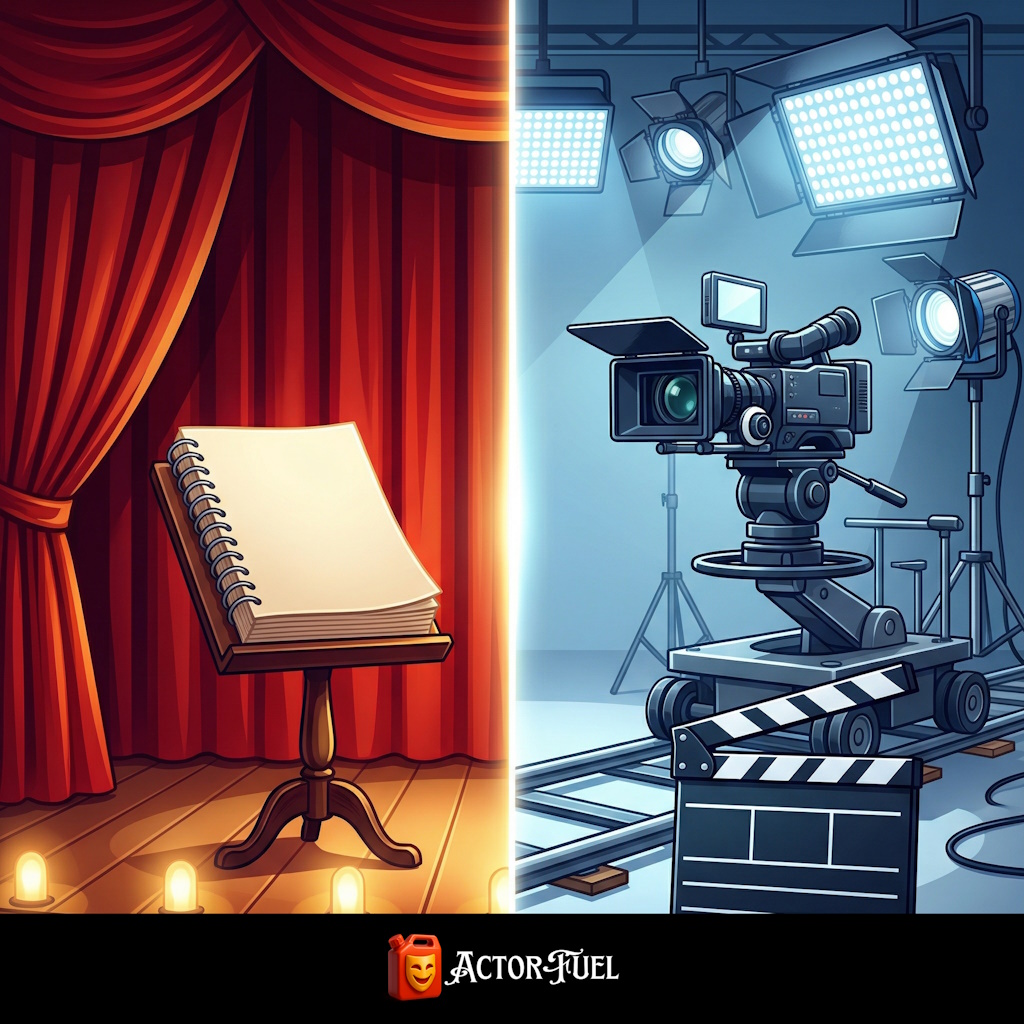
A playwright writes words to be spoken aloud by living performers in a shared physical space with an audience. A screenwriter writes a visual blueprint to be interpreted by a director, shot by a camera, and assembled by an editor into a fixed visual experience. Both tell stories through characters and dramatic structure. But the tools they use, the degree of control they retain, and the experience they create for the audience are profoundly different.
Think of it this way: a play is a concert.
The audience hears the writer’s words performed live, in the moment, unrepeatable. A film is a studio album. It’s recorded, mixed, edited, and polished into a finished product that plays the same way every time. Both create powerful experiences, but the process of creating them—and the writer’s role in that process—is fundamentally different.
Creative Control: Who Owns the Words?
Here you’ll learn the single biggest practical difference between the two roles—and why it matters for every writer’s career decisions.
In theater, the playwright is the primary creative authority. Under the standard Dramatists Guild agreement in the United States, no one—not the director, not the producers, not the actors—may change a single word of the script without the playwright’s explicit permission. The text is legally protected. If an actor ad-libs a line, that line exists only in the moment and carries no legal standing. The playwright’s words are, as the industry puts it, “set in stone.”
This gives playwrights an extraordinary level of creative control that writers in almost no other medium enjoy.
In film and television, the dynamic is reversed. The screenwriter’s script is treated as a blueprint—a starting point. Directors routinely make changes during shooting. Editors reshape the story in post-production. Producers and studios may commission rewrites by other writers. It is common for a finished film to differ significantly from the original screenplay, and the original writer may not even be credited on the final product. As one industry saying goes: “A film is made in the editing room.”
The screenwriter rarely controls what happens there.
This difference is not merely technical. It shapes the entire creative experience. If you are a writer who values absolute ownership of your words and wants your vision performed as you wrote it, playwriting offers a level of authority that screenwriting does not.
If you are comfortable with collaboration, reinterpretation, and the possibility that your script will evolve dramatically through the production process, screenwriting’s more fluid structure may suit you.
Dialogue vs. Image: The Primary Storytelling Tool
In this section you’ll understand the most fundamental creative difference between the two crafts—and why mastering one doesn’t automatically mean you can do the other.
In playwriting, dialogue is king. Characters reveal themselves, advance the plot, build relationships, and create emotional impact primarily through what they say. A playwright’s most powerful tool is the spoken word—its rhythm, its subtext, its silences. Visual elements on stage (set design, lighting, blocking) reinforce the dialogue; they rarely replace it.
The audience in a theater is often too far from the stage to read subtle facial expressions, so the words must carry the weight of the storytelling.
In screenwriting, the governing principle is “show, don’t tell.” The camera can zoom into a character’s trembling hand, cut to a reaction shot, reveal an entire world through a single image. A great screenplay uses dialogue sparingly—only when images cannot convey the information alone. Screenwriters describe action, setting, and visual detail extensively because the director and cinematographer need to see the film in their minds before they shoot it.
A playwright would never write “CLOSE-UP on her face as a single tear rolls down her cheek.” A screenwriter does this routinely.
Joey Madia, a playwright with over twenty produced stage works who transitioned to screenwriting, described the challenge perfectly: the steepest learning curve when moving from playwriting to screenwriting is getting away from reliance on the word and finding images that drive your narrative.
For writers whose instinct is to express everything through dialogue, this shift is genuinely difficult—and it’s the reason many brilliant playwrights struggle when they first attempt a screenplay.
Want to master the art of writing for the stage? The S.C.R.I.P.T. Method is a free 5-day email course that teaches you dramatic structure, character creation, and dialogue that actors love to perform—built specifically for live theater, not adapted from screenwriting. Click here to get it for free
Scope, Scale, and the Rules of Each Medium
Here you’ll see the practical constraints that shape what each type of writer can—and cannot—put on the page.
Locations and settings
A screenplay can move freely across the globe—and beyond.
James Bond can jump from a helicopter in Istanbul, crash through a window in London, and end up in a submarine under the Arctic. A stage play, constrained by physical reality, typically unfolds in one to three locations. This is not a limitation—it’s a discipline.
The constraint forces playwrights to deepen their characters and sharpen their dialogue, because they cannot rely on spectacle or a change of scenery to hold the audience’s attention.
Cast size
Stage plays generally favor smaller casts—fewer characters allow deeper exploration and reduce production costs.
Screenplays routinely feature large casts plus background extras to populate the visual world. A screenplay can introduce a character for a single scene; a play rarely wastes a character on a brief appearance, because every actor on stage requires rehearsal time, costume, and a reason to exist in the story.
Time and structure
Most stage plays follow a two-act structure with an intermission, running 90 minutes to two and a half hours.
Scenes tend to be longer and more self-contained than in film. Screenplays follow a three-act structure (or variations), typically running 90 to 120 pages. Film scenes are often shorter and cut more rapidly, because the camera and editing can compress time in ways that a live stage cannot.
Special effects and spectacle
Film can create any visual experience imaginable—explosions, space travel, time manipulation, digital characters.
Theater is fundamentally analog: real bodies, real objects, real light, in real time. The playwright works within these constraints and uses them creatively. A single lamp can suggest an entire room. A sound effect can evoke a battlefield. The audience’s imagination fills the gaps—and that shared act of imagination is part of what makes theater powerful.

The Career Realities: How the Two Worlds Work
This section gives you an honest picture of what each career path actually looks like—including the parts nobody tells you.
Screenwriting, at the upper levels, pays significantly more than playwriting. A feature screenplay can command hundreds of thousands of dollars; a television staff writing position offers a steady salary. By comparison, even a successful Off-Broadway play may earn its author a modest advance and a small percentage of ticket sales. The financial reality is that most working playwrights support themselves with other income—teaching, freelance writing, grants—while screenwriters who break into film or television can earn a living from writing alone.
The trade-off is creative control.
A playwright whose work is produced retains ownership of their text and can influence how it is performed for the rest of their life. A screenwriter who sells a script may never see it produced, or may see it produced in a form they barely recognize. The emotional experience of the two careers is also different: a playwright sits in the audience and watches their words performed live, feeling every laugh and silence in real time.
A screenwriter sees the finished film months or years after writing it, often with significant changes they did not make.
Both careers are difficult to break into. Both reward persistence, craft, and the willingness to rewrite relentlessly. And increasingly, writers work across both mediums—especially as streaming platforms blur the line between film and theater-style storytelling.
From Stage to Screen (and Back): When Writers Cross Over
Here you’ll see how the transition works in practice—and why some of the greatest screenwriters in history started on stage.
Aaron Sorkin is the most famous example of a playwright who became a screenwriter without losing his theatrical DNA. Sorkin studied Musical Theatre at Syracuse University and wrote A Few Good Men first as a stage play, which opened on Broadway in 1989. The legendary screenwriter William Goldman saw the script and took Sorkin under his wing with a specific goal: to turn him from a playwright into a playwright who could also write movies.
Sorkin adapted A Few Good Men into a feature film in 1992, and his career exploded.
But his screenwriting style remains unmistakably theatrical: dense dialogue, extended monologues, characters who argue with the precision of courtroom lawyers. His theatrical roots are both his signature strength and the reason his work occasionally feels more like a stage play captured on camera than a true piece of cinema.
David Mamet, Mike Leigh, Tom Stoppard, Tony Kushner, and Tracy Letts are other prominent writers who have moved between stage and screen with varying degrees of adaptation.
The common thread: all of them brought exceptional dialogue skills from the theater, and all of them had to learn the visual grammar of film as a separate discipline. The transition is not automatic. A great play is not a great screenplay in different formatting.
Each medium has its own rules, and the writers who thrive in both are the ones who respect those rules instead of assuming that good writing is good writing regardless of medium.
The reverse transition—screenwriters moving to theater—is less common but increasingly visible.
Writers from television, where long-form character development resembles the depth of stage writing more than film does, have found natural crossover points. The key insight for anyone considering the transition in either direction: the storytelling instincts transfer, but the craft-specific skills do not.
A playwright moving to screenwriting must learn to think in images. A screenwriter moving to playwriting must learn to trust dialogue as the primary vehicle for everything.
FAQ
Q: What does a playwright do exactly?
A: A playwright writes scripts for live theater performance. This includes creating the story, characters, dialogue, and stage directions. Playwrights typically collaborate with directors and actors during rehearsals to refine the script, and they retain legal control over their text under standard industry agreements.
Q: Can a playwright also be a screenwriter?
A: Yes. Many successful writers work in both mediums. Aaron Sorkin, David Mamet, Tony Kushner, and Tracy Letts have all written for both stage and screen. The storytelling skills overlap significantly, but each medium requires specific craft knowledge that must be learned separately.
Q: Is playwriting harder than screenwriting?
A: Neither is inherently harder—they are different disciplines with different challenges. Playwriting demands mastery of dialogue and the ability to tell a complete story within tight physical constraints. Screenwriting demands visual storytelling, structural precision across a longer format, and the ability to write for a collaborative production process where the writer has less control.
Q: Do playwrights get paid more than screenwriters?
A: Generally, no. Screenwriting—especially in television—pays significantly more than playwriting at comparable career levels. Most working playwrights earn modest income from their plays and supplement with teaching, grants, or other writing work. Screenwriters who break into studio film or television staff positions can earn a full-time living from writing.
Q: What skills transfer from playwriting to screenwriting?
A: Dialogue writing, character development, dramatic structure, conflict construction, and the ability to write scenes driven by what characters want are all highly transferable. The main skill that does not transfer is visual storytelling—learning to drive narrative through images and action rather than through dialogue.
Q: Do I need a degree to be a playwright or screenwriter?
A: No. Neither career requires a formal degree. MFA programs in playwriting and screenwriting can provide valuable training, mentorship, and industry connections, but many successful writers in both fields are self-taught or trained through workshops, reading groups, and professional experience.
Sources
Final Draft — “Playwriting vs. Screenwriting: Key Differences Every Writer Should Know” — detailed comparison of creative control, collaboration, and format differences.
Stage 32 — “7 Differences Between Writing for the Stage and Writing for the Screen” — practitioner’s perspective from a playwright who transitioned to screenwriting.