
Your first acting audition is coming up, and you have no idea what to expect.
You’ve memorized your lines (maybe), you’ve picked an outfit (probably wrong), and you’re oscillating between irrational confidence and full-blown panic. Good news: that’s completely normal. Better news: acting audition tips for beginners are not about eliminating your nerves. They’re about channeling them into something useful.
I’ve been on both sides of the audition table—as an actor performing and as a producer watching hundreds of actors walk through the door.
The difference between the ones who get remembered and the ones who blur together has almost nothing to do with raw talent. It has everything to do with preparation, specificity, and professionalism. These are learnable skills. And once you learn them, every audition becomes an opportunity instead of an ordeal.
This article gives you a complete audition system: what to do before, during, and after every audition.
Ten specific tips that actually work, plus guidance on self-tapes, follow-ups, and the mindset shift that separates working actors from perpetually anxious ones. By the end, you’ll know exactly how to walk in prepared and walk out knowing you gave your best.
In 30 seconds:
- The audition starts before you enter the room—your preparation, punctuality, and energy are all being evaluated.
- Making a bold, specific choice always beats playing it safe—casting directors remember actors who commit.
- Auditioning is a learnable skill separate from acting itself—you can train for it deliberately.
Key takeaways:
- Preparation is the edge: The actors who stand out are the ones who read the full script, researched the project, and made specific character choices before walking in.
- Auditioning is its own skill: Being a great auditioner and being a great actor are different things—both are trainable, and you need both.
- Casting directors are on your side: They genuinely want you to be the answer to their problem, not another person to reject.
- Bold beats safe: A committed, specific interpretation is always more memorable than a technically correct but generic performance.
- After the audition matters: How you follow up, self-assess, and move on is part of building a sustainable career—not just booking one role.
Quick definitions:
- Open call: An audition open to anyone, without an agent or invitation required—the most accessible entry point for beginners.
- Callback: A second (or third) audition for actors who impressed in the initial round. Getting a callback means you’re being seriously considered.
- Sides: The specific pages or scenes from a script that you’re given to prepare for an audition.
- Cold reading: Performing material you’ve been given with little or no preparation time—tests your instincts and ability to make quick choices.
- Self-tape: A recorded audition you film yourself and submit digitally. Now the dominant audition format in film and television.
- Headshot and resume: Your calling card—a professional photograph and a one-page summary of your training, experience, and special skills.
- Reader: The person who reads the other character’s lines opposite you during an audition.
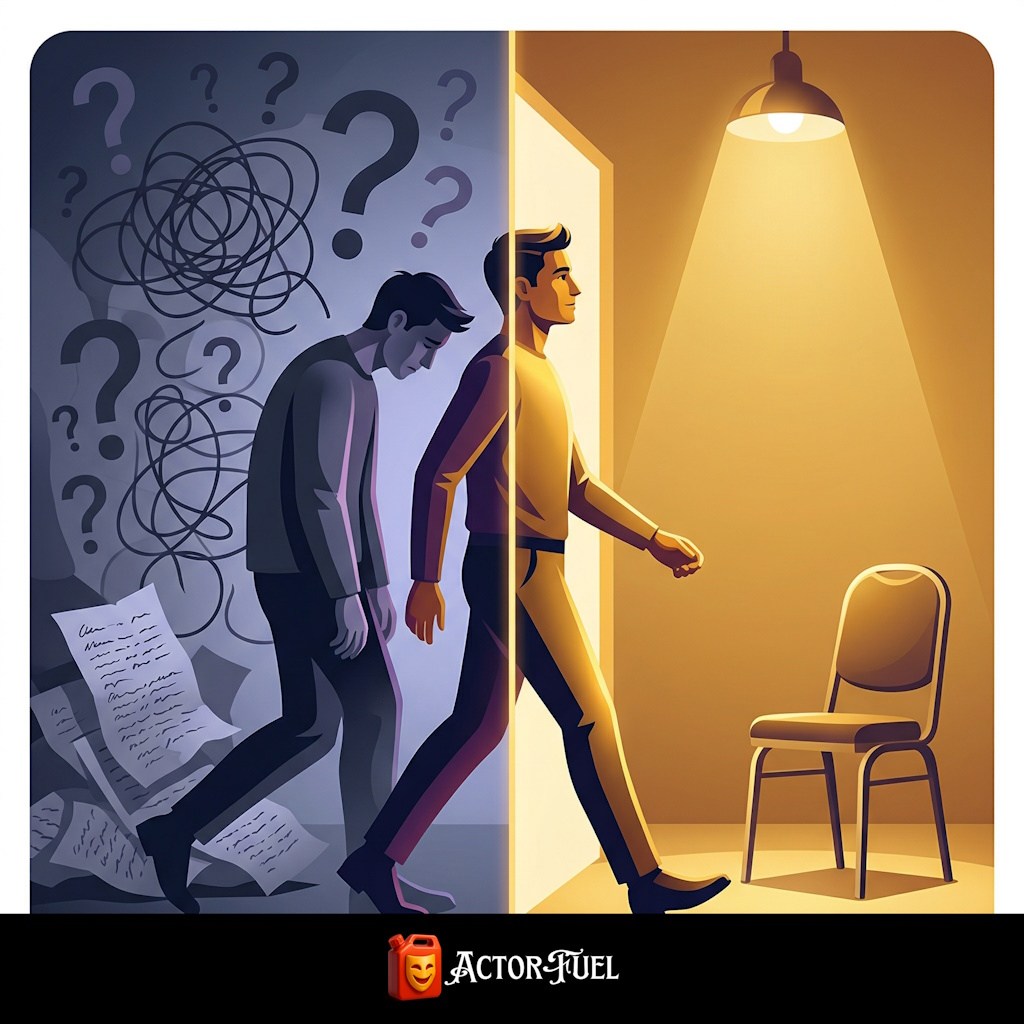
Before You Walk In: Preparation That Sets You Apart
This section covers everything you need to do before the audition day—the work that separates prepared actors from hopeful ones.
Read the full script, not just your sides
If the script is available, read it cover to cover. Not just your scenes—the whole thing.
You need to understand the story, the world, the tone, the relationships, and where your character fits in the larger arc. Casting directors can immediately tell when an actor understands the full context versus one who has only looked at their own lines. If the script isn’t available, research the project: the writer, the director, the production company, the genre.
Any context you can gather informs smarter choices.
Make specific character choices
Do not walk into an audition with a vague plan to “feel it out.” Before you arrive, decide:
- what does your character want in this scene?
- What is stopping them from getting it?
- What is their emotional state at the start of the scene, and how does it change?
These specific choices give your performance direction and energy. You can always adjust if the casting director gives you a redirect—but you need a clear starting point. An actor with a strong, committed choice who pivots on direction is infinitely more impressive than an actor who walks in blank and waits to be told what to do.
Prepare your materials
Bring printed copies of your headshot and resume, even if you’ve submitted them digitally.
Have your sides printed and highlighted. If you’re performing a monologue, have it memorized cold—not “mostly memorized.” Bring a water bottle. Wear clothes that suggest your character without being a full costume: if you’re auditioning for a lawyer, a blazer works; if you’re auditioning for a student, keep it casual. Avoid logos, busy patterns, and anything that distracts from your face.
Arrive 15 minutes early
Punctuality is the most basic form of professionalism, and it’s the first thing casting teams notice.
Arriving early gives you time to check in, calm your nerves, review your sides one last time, and observe the environment. Being late—even by five minutes—communicates that you’re unreliable. In a profession built on tight schedules and ensemble work, unreliable is a career-ending reputation.

In the Room: 10 Acting Audition Tips That Actually Work
Here are ten specific, practical tips you can use in every audition—starting with the next one.
1. The audition starts when you open the door
Casting directors are evaluating you from the moment you walk in.
Your posture, your energy, your eye contact, your handshake, your smile—all of this creates an impression before you say a single line. Walk in with your head up, make eye contact, and introduce yourself with warmth and confidence. You are not begging for a job. You are a professional offering your skills.
2. Don’t apologize
Never open with an excuse:
- “Sorry, I’m a little nervous,”
- “Sorry, I’m coming down with something,”
- “Sorry, I just got the sides last night.”
Apologies lower your status in the room and invite the casting director to view your performance through a lens of sympathy rather than respect. If you’re nervous, that’s fine—everyone is. Channel it into the work.
3. Make a bold, specific choice
The biggest mistake beginners make is playing it safe—delivering a technically adequate but completely forgettable performance.
Casting directors see dozens (sometimes hundreds) of actors for the same role. The ones they remember are the ones who committed fully to a specific interpretation. When Robin Williams auditioned for the role of Mork in Happy Days, the show’s creator Garry Marshall asked him to take a seat. Instead of sitting in the chair normally, Williams sat on it upside down—on his head—and conducted the entire audition as if he were an actual alien. He got the role, which launched his career on Mork & Mindy. You don’t need to sit on your head.
But you do need to make a choice that is yours, commit to it fully, and let the casting director see a human being with a point of view—not a blank canvas hoping to be painted on.
4. Don’t look at the casting director (unless told to)
During your performance, treat the casting table as the audience—not your scene partner.
Direct your performance to your reader or to an imaginary point just off-camera. Looking directly at the casting director breaks the fourth wall and makes the room uncomfortable. The exception: if they specifically ask you to address them, follow the instruction.
5. Listen to your reader
An audition is not a solo performance.
Even if your reader is flat or disengaged, your job is to listen and react truthfully to what they give you. Genuine listening—actually taking in what the other person says before responding—is one of the clearest signals of a trained actor. It makes your performance feel alive and spontaneous rather than rehearsed and mechanical.
6. Take direction gracefully and immediately
If the casting director gives you a redirect (“Can you try it angrier?” “What if she’s hiding something?”), take a breath, adjust, and go again.
Do not explain your original choice. Do not argue. Do not freeze. The redirect is not a criticism—it’s a test of whether you can collaborate. Debi Manwiller, casting director at USC’s School of Dramatic Arts, has noted that she never directs actors on the first take because she wants to see their instincts first. When she does give direction, she’s looking for adaptability, not obedience.
7. Recover from mistakes without stopping
If you forget a line, stumble over a word, or lose your place, keep going.
Do not stop, apologize, or ask to start over (unless the mistake completely derails the scene). Most of the time, the casting director didn’t notice the mistake—or didn’t care. What they do notice is how you handle pressure. An actor who recovers smoothly from a flub shows resilience and professionalism. An actor who crumbles shows fragility.
8. Keep it to the right scale
Match your performance to the medium.
A film or television audition requires subtlety—the camera catches everything, so you can trust small, truthful choices. A theater audition for a large venue requires more vocal and physical energy. Ask yourself before every audition: how close is the audience (or the camera) to me? Adjust your scale accordingly.
9. Finish strong and leave clean
Your last moment is your lasting impression.
Hold your final beat for a second after your last line—don’t drop character immediately. Then calmly return to yourself, make eye contact with the casting director, say “Thank you,” and leave. Do not linger. Do not ask for feedback. Do not ask how you did. Walk out with the same confidence you walked in with.
10. Remember: they want you to succeed
This is the most important mindset shift for beginners.
Casting directors are not judges looking to reject you. They are problem-solvers looking for the right person to fill a role—and they desperately want you to be that person. Every actor who walks through the door is a potential solution to their problem. They are rooting for you. Walk in knowing that, and the entire dynamic of the room shifts in your favor.
Want to build a repeatable pipeline of auditions and paying work? The P.R.O.F.I.T. Method is a free 5-day email course that helps actors position themselves, build outreach systems, and turn talent into income. Click here to get it for free
Self-Tapes: The Audition Format You Must Master
In this section you’ll learn why self-tapes are now the dominant audition format—and how to create ones that stand out.
Since the pandemic, self-taped auditions have become the industry standard for film and television. Instead of performing live in front of the casting team, you record yourself performing the sides and submit the video digitally. This gives you more control over your performance (you can do multiple takes) but also means you’re competing against potentially hundreds of recordings—so production quality and performance quality both matter.
The essentials: film at eye level, in a well-lit space with a plain, neutral background.
Use natural light or a simple ring light—avoid harsh overhead lighting that creates shadows under your eyes. Frame yourself from the chest up. Keep the camera still (use a tripod or stack of books). Record clean audio—a quiet room matters more than an expensive microphone. Have a reader deliver the other character’s lines off-camera, close to the lens so your eyeline is near the camera without looking directly into it. Slate at the beginning: state your name, the role you’re auditioning for, and your height. Keep it brief and professional.
The most common self-tape mistake is over-producing.
Casting directors are watching for your performance, not your cinematography. A clean, well-lit tape with a compelling performance beats a technically polished tape with generic acting every time. Invest your energy in the choices, not the equipment.
After the Audition: What to Do Next
This section covers the part most beginners ignore—the follow-up habits that build a career over time.
Let it go
The moment you leave the room (or hit submit on a self-tape), the audition is over.
You cannot change what happened. Replaying it in your head, analyzing every micro-expression on the casting director’s face, and spiraling into “I should have done it differently” is a waste of mental energy. Your job was to prepare, show up, and give your best. You did that. Now move on.
Do a brief self-assessment
After a few hours (not immediately), take five minutes to note what went well and one thing to improve next time.
Keep this factual, not emotional. “I listened well and took the redirect smoothly. Next time I want to arrive with a stronger second choice ready.” Over months, this creates a log of your growth as an auditioner—concrete evidence that you’re getting better, which is far more useful than vague feelings of progress or failure.
Follow up appropriately
If you have an agent, they handle follow-up.
If you’re unrepresented and have the casting director’s contact information, a brief, professional thank-you email within 24 hours is appropriate. Keep it one or two sentences: “Thank you for the opportunity to audition for [role]. I enjoyed the material and appreciate your time.” Do not ask about the decision. Do not send multiple follow-ups. Professionalism here builds the kind of reputation that gets you invited back—even for different projects down the line.
Track everything
Keep a simple spreadsheet of every audition: date, project, role, casting director, how you found it, whether you got a callback, and any notes.
Over time, this data reveals patterns—which platforms yield the most auditions, which types of roles get you callbacks, which casting directors have seen your work. This is the beginning of a professional pipeline, and it’s exactly the kind of business system that separates actors who build careers from actors who just hope for the best.
The Mindset Shift: Auditions Are Not Judgments
Here you’ll learn the one mental reframe that changes everything about how you experience auditions.
Most beginners walk into auditions with a question burning in their chest: “Am I good enough?” That question poisons everything. It makes you needy. It makes you defensive. It makes you perform for approval instead of performing with conviction. And ironically, it makes you less likely to get cast—because casting directors can smell desperation.
The reframe: an audition is not a judgment of your worth.
It is a business meeting where you present your interpretation of a role, and the casting team decides whether that interpretation fits what they need for this specific project. If it fits, you book the job. If it doesn’t, it means you weren’t the right match—the same way a blue shirt isn’t the right match for someone looking for a red one. The blue shirt is not “bad.” It’s just not what they needed today. This reframe is not just positive thinking. It’s the literal truth of how professional casting works. Manwiller, the casting director at USC, put it plainly: “We didn’t know we needed Zendaya or Timothée Chalamet until they surfaced.” The casting director is not looking for perfection. They are looking for the unexpected right person. Your job is to walk in and show them who you are with clarity, confidence, and commitment. The rest is not in your hands—and that’s not a failure. That’s the profession.
FAQ
Q: What should I wear to an acting audition?
A: Wear something that subtly suggests your character without being a full costume. A blazer for a professional role, casual clothes for a student role, dark colors for a serious drama. Avoid busy patterns, large logos, and anything that distracts from your face. Comfort matters—you need to be able to move freely and focus on your performance.
Q: Do I need an agent to get auditions?
A: No. Many auditions—especially for theater, student films, indie projects, and commercials—are accessible without an agent through open calls and online casting platforms like Backstage, Casting Networks, and Actors Access. An agent becomes more valuable as you advance, but beginners can build significant experience and credits without one.
Q: How long does a typical audition last?
A: Most auditions last 5 to 15 minutes. First impressions form in seconds, so your preparation and entrance matter enormously. Callbacks may run longer, especially if you’re asked to read with other actors or try multiple scenes.
Q: What if I forget my lines during an audition?
A: Keep going. Paraphrase if necessary. Do not stop and apologize. Casting directors care far more about your ability to recover under pressure than they do about word-perfect delivery. A confident actor who improvises through a forgotten line is more castable than a technically perfect actor who panics when something goes wrong.
Q: How do I find auditions as a beginner?
A: Start with online casting platforms (Backstage, Casting Networks, Actors Access), local community theater postings, drama school notice boards, and social media groups for actors in your area. Indie films, student projects, and short films are excellent starting points because they actively seek fresh faces and rarely require agent submissions.
Q: Should I take acting classes before auditioning?
A: Classes are not a prerequisite, but they give you a significant advantage. Training builds technique, confidence, and the ability to make quick, bold choices under pressure—all of which directly improve your audition performance. Even a short introductory course or workshop before your first audition can make a meaningful difference.
Sources
Backstage — “10 Acting Audition Tips to Help You Land the Role” — practical audition guidance from a New York-based acting coach with 30+ years of industry experience.
USC School of Dramatic Arts — “How to Nail Your Next Audition” — insights from USC faculty and casting professionals on what makes actors stand out in the audition room.