
Community theater auditions are one of the most accessible entry points into the performing arts.
- No agent required.
- No union card.
- No professional credits.
You just show up, read some lines, and see what happens. That openness is what makes community theater special — and it’s also what makes people underestimate the process. Because “welcoming” doesn’t mean “unprepared wins.”
I’ve spent over 15 years in theater as an actor, producer, and consultant, and I’ve been on both sides of the audition table. I’ve watched talented people walk in with zero preparation and leave wondering why they didn’t get cast. I’ve watched nervous first-timers who did their homework walk out with lead roles. The difference almost never comes down to raw talent.
It comes down to understanding what’s actually happening in that room and showing up ready for it.
This article is the guide I wish every first-time auditioner had. By the end, you’ll know how to find community theater auditions, what happens step by step, how to prepare for every format you’ll encounter, the mistakes that quietly kill your chances, and what to do after the audition — whether you get cast or not.
In 30 seconds:
- Community theater auditions welcome all experience levels, but preparation is what separates people who get cast from people who don’t.
- Reading the script beforehand is the single biggest advantage most auditioners skip.
- Directors cast reliability and attitude as much as talent — being someone people want to work with matters enormously.
Key takeaways:
- Low barrier, high reward: Community theater auditions are designed to be inclusive, but that doesn’t mean showing up unprepared will work.
- Read the script first: It’s the most skipped and most impactful preparation step.
- Reliability is currency: Directors value people who show up on time, learn their lines, and are easy to work with.
- Cold reading is the key skill: Most community auditions use cold readings, so developing this skill gives you a real edge.
- Rejection is normal: Not getting cast isn’t personal failure — it’s how the process works, and every audition makes you sharper.
Quick definitions:
- Cold reading: Performing a script you haven’t seen before (or have only briefly reviewed), reading directly from the page.
- Callback: A second audition where the director sees specific actors again, often reading with different scene partners to test chemistry.
- Sides: Short sections of the script provided to actors to prepare or read during the audition.
- Monologue: A solo speech, typically 60–90 seconds, sometimes required as a prepared audition piece.
- Ensemble: The group of performers in a production, often referring to non-lead roles that form the backbone of the show.
- Type/typecasting: Casting based on an actor’s physical appearance, age, or perceived persona matching a character.
What Are Community Theater Auditions, and Who Are They For?
Community theater auditions are open casting calls held by amateur and semi-professional theater companies.
Unlike professional auditions, which typically require union membership, agent submissions, or prior credits, community theater welcomes anyone who wants to participate. That includes complete beginners, people returning to theater after years away, retirees, students, and working professionals who perform as a hobby.
The atmosphere is generally friendlier and lower-pressure than professional auditions, but make no mistake: there is still a selection process. Directors are casting a show. They need specific roles filled. They’re looking for the best combination of talent, reliability, and chemistry to create a strong production. The people who treat the process seriously — even in a casual environment — are the ones who get cast.
Here’s something I want to say clearly, because it’s true and it’s important: community theater has produced some remarkable actors.
Andrew Rannells, Constance Wu, and Willem Dafoe all started on local stages. At age 13, Dafoe caught the attention of a Wisconsin newspaper critic who noted that the young actor didn’t just memorize lines — he genuinely acted and reacted on stage. You never know where a community stage will take you. But more importantly, even if it takes you nowhere beyond the local playhouse, the experience of creating live theater with other people is profoundly rewarding in itself.
How to Find Community Theater Auditions Near You
Finding auditions is easier than most people think, but it requires looking in the right places. Here are the most reliable channels.
Local theater company websites and social media are your first stop. Most community theaters post their season schedule and audition dates on their website and Facebook or Instagram pages. Follow every company within driving distance. Many post audition notices three to four weeks before the audition date, so checking regularly matters.
Online casting platforms aggregate audition listings from multiple theaters. Backstage.com is the industry standard and includes community theater listings alongside professional ones. Other useful platforms include Playbill.com, local theater Facebook groups, and community event boards on sites like Nextdoor.
Word of mouth is surprisingly powerful in community theater. If you know anyone involved in local theater — even peripherally — ask them. Theater people love recruiting new blood. A single conversation can connect you to three companies you didn’t know existed.
Community centers, libraries, and local newspapers often carry audition notices, especially for smaller companies that rely on physical flyers and local press rather than social media. Don’t overlook these analog channels. Some of the best community theaters in any town do minimal online marketing.
The 3 Audition Formats You’ll Encounter
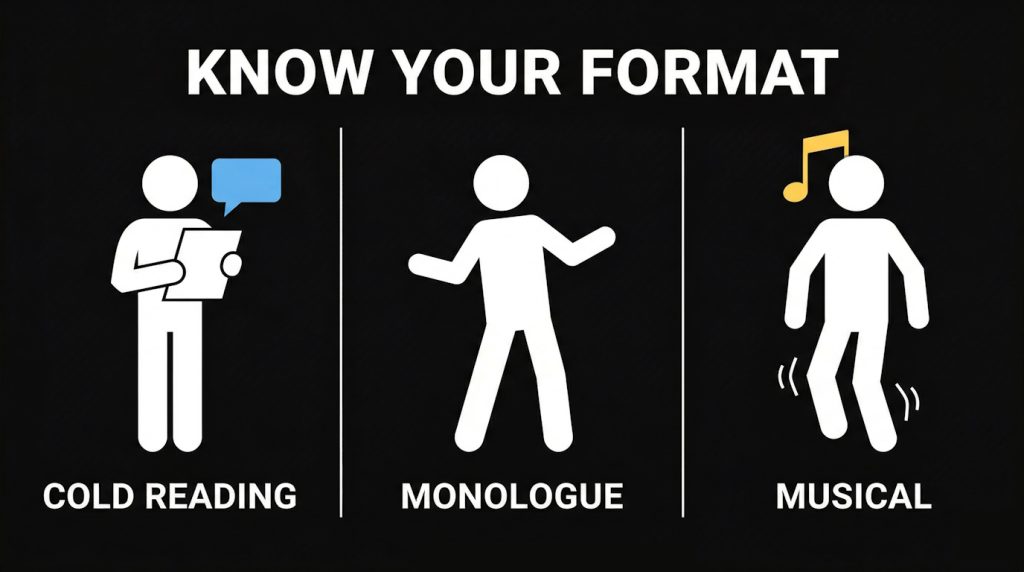
Community theater auditions typically follow one of three formats. Knowing which one you’re walking into — and how to prepare for each — is a significant advantage.
1. Cold Readings
This is the most common format in community theater.
The director provides sides — short excerpts from the script — and asks you to read them on the spot, usually with another auditioner or a stage manager reading the other part. You may get a few minutes to look over the sides before reading, or you may be handed them and asked to go immediately. Cold reading is a skill. It’s not about memorization or polish. It’s about your ability to understand a scene quickly, make clear choices, listen to your scene partner, and react in the moment.
Directors use cold readings because they reveal how an actor thinks on their feet — which is exactly what rehearsals demand.
2. Prepared Monologues
Some auditions ask you to bring a prepared monologue, typically 60 to 90 seconds long.
The audition notice will usually specify whether they want a comedic or dramatic piece, contemporary or classical, and any other parameters. If they don’t specify, choose a contemporary monologue that suits your age and type, from a published play (not a film or original writing). The monologue should show range — an emotional shift, a clear objective, and a sense of who you’re talking to. Avoid overdone pieces that every auditioner uses.
And always, always be fully memorized. Reading from a page during a “prepared” monologue signals that you didn’t prepare.
3. Musical Auditions
If the production is a musical, expect to sing, dance, and possibly do a cold reading as well.
For singing, you’ll typically be asked for 16 to 32 bars of a song — about a verse and chorus. Bring sheet music in the correct key for the accompanist (digital tracks or a cappella are usually acceptable only if the notice says so). For the dance portion, a choreographer will teach a short combination and watch how you pick it up. You don’t need to be a trained dancer. They’re assessing musicality, coordination, and willingness to commit. For the reading portion, the same cold reading principles apply.
Want to understand how the theater world works from the production side? The T.H.R.I.V.E. Method is a free 5-day email course for producers, but actors who understand how shows get marketed and how audiences get built have a real advantage in every audition room. Click here and get it for free
How to Prepare for Community Theater Auditions
Preparation is what separates the people who get cast from the people who “just showed up.” Here’s a step-by-step approach that works regardless of format.
Read the Script
This is the single most impactful thing you can do, and it’s the step most community theater auditioners skip entirely.
If the script is available — at the library, online, or as a perusal copy from the theater — read the whole thing. Not just the role you want. The whole play. You’ll walk in understanding the world, the relationships, the tone, and the arc of the story. When the director gives you sides, you’ll know where that scene fits, what just happened before it, and what’s at stake. That context shows in your reading. It makes your choices specific instead of generic.
And it signals to the director that you’re serious.
Research the Company
Spend 15 minutes on the theater company’s website.
- What have they produced recently?
- What’s their aesthetic?
- Are they known for traditional productions or experimental work?
- Are they a family-friendly company or do they tackle edgier material?
This context helps you calibrate your audition. It also gives you something intelligent to say if the director makes conversation. Small thing, big impact.
Prepare Your Cold Reading Skills
Since cold readings are the most common format, developing this skill pays off enormously.
The key principles are simple: scan the sides quickly for the basic situation (who are you, who are you talking to, what do you want), make a clear choice about your character’s objective even if it’s a guess, hold the script up so you can glance at lines while keeping your eyes on your scene partner as much as possible, and listen — genuinely listen — to the other person instead of just waiting for your next line. Practice at home by grabbing any play and reading scenes aloud with minimal preparation.
The more you do this, the more comfortable and natural you’ll become.
Check Your Schedule Before You Audition
This might sound like basic logistics, but it’s one of the most important things you can do.
The audition notice will list rehearsal dates and performance dates. Check every single one against your calendar before you walk in the door. If you have conflicts, note them honestly on the audition form. Nothing frustrates a director more than casting someone who then reveals they can’t make half the rehearsals.
Reliability is currency in community theater, and it starts before you open your mouth.
What Happens in the Audition Room
Here’s a realistic walkthrough of what most community theater auditions look like, so you know exactly what to expect.
Arrival and paperwork. You’ll arrive, sign in, and fill out an audition form with your contact information, any schedule conflicts, relevant experience, and sometimes a headshot (a casual photo is fine — professional headshots are not expected). You may wait in a lobby or holding area with other auditioners. Be friendly. Be calm. The people around you might be your future castmates.
The audition itself. Depending on the format, you’ll either perform your prepared piece or be given sides to read. For cold readings, you may be called individually into a room with the director and creative team, or you may read in a group setting where everyone watches. Both are normal. When you read, commit to your choices. It’s better to make a bold, wrong choice than a safe, forgettable one. Directors can redirect a strong choice. They can’t work with nothing.
Direction and adjustments. Good directors will often give you a note after your first read and ask you to try it again differently. This is not criticism. This is the most valuable part of the audition. It shows the director how you take feedback, how quickly you can adapt, and whether you’re the kind of actor who gets better in the room. When you get a redirect, don’t apologize for your first read. Just listen, make the adjustment, and go again.
After you read. Thank the director, collect your things, and leave cleanly. Don’t linger to ask about your chances or request to read for additional roles. The director has seen what they need to see. If they want more from you, they’ll call you back.
The Mistakes That Kill Your Chances (and How to Avoid Them)
After years on both sides of the audition table, I’ve seen the same mistakes repeated constantly. Recognizing them gives you an immediate advantage over most auditioners.
Not Reading the Script
I cannot stress this enough.
The majority of community theater auditioners walk in having never read the play. They’re guessing at the character, the tone, and the stakes. The person who has read the script makes choices that are grounded and specific. The person who hasn’t makes choices that are generic and forgettable. If only one person in the room has read the play, that person has an enormous advantage. Be that person.
Treating It Like a Casual Hangout
Community theater is friendly.
It’s also a commitment. Directors notice everything: did you arrive on time, did you fill out the form completely and honestly, did you pay attention while others read, did you follow instructions. A relaxed atmosphere doesn’t mean professionalism doesn’t matter. The director is assembling a team they’ll spend weeks with in rehearsal. They’re looking for people who will make that process smooth, not stressful.
Only Wanting the Lead
Walking into an audition fixed on one specific role is a recipe for disappointment.
Directors cast shows, not individual roles. They’re looking for the best overall combination of actors. Being open to any role — and meaning it — dramatically increases your chances of being cast. Ensemble roles and supporting parts build experience, relationships, and credibility. Many of the best actors in any community theater company earned their leads by being outstanding in smaller roles first.
Ignoring the Other Actors in the Room
Some auditioners treat the process like a solo performance.
They focus entirely on their own lines and delivery, barely registering the person reading opposite them. Directors see this immediately, and it’s disqualifying. Acting is reacting. If you’re not genuinely listening and responding to your scene partner during the audition, the director knows you won’t do it in rehearsal either. Put your attention on the other person. Let their words affect you. React truthfully. This alone will set you apart from most auditioners.
Apologizing for Your Work
Never preface your audition with “Sorry, I’m so nervous” or follow it with “That wasn’t very good.”
The director forms their own opinion. Apologizing before or after your read only plants doubt. Everyone is nervous. That’s normal. Channel the nerves into the work instead of narrating them.
What Happens After the Audition
The waiting period after a community theater audition can feel agonizing. Here’s what’s actually happening behind the scenes and how to handle every outcome.
Callbacks
Some directors hold callbacks — a second round where specific actors are invited back to read again, often with different scene partners. A callback means the director is seriously considering you for a role and wants to see more. Not getting a callback doesn’t necessarily mean you’re out — some directors make all their casting decisions from the initial audition. If you are called back, prepare the same way: read the script again, review the sides, and come ready to take direction.
Cast Lists and Communication
Most companies post cast lists within one to two weeks of auditions, via email, phone call, or a posting on their website or social media. Some companies notify everyone, including those not cast. Others only contact the people who got roles. If you haven’t heard anything after two weeks, it’s appropriate to send a brief, polite email asking about the status.
If You Get Cast
Congratulations.
Now the real work begins. Respond promptly. Review the rehearsal schedule carefully. Start learning your lines immediately — don’t wait until the director tells you to be off-book. Show up to every rehearsal on time, warmed up, and ready to work. Be generous with your scene partners. Take direction gracefully. The reputation you build during this production determines whether you’re invited back for the next one.
If You Don’t Get Cast
This is the part nobody talks about enough, so let me be direct.
Not getting cast is not a judgment of your talent. Directors make casting decisions based on a complex web of factors: physical type, vocal range, chemistry between actors, schedule availability, the overall balance of the cast, and sometimes pure logistical necessity. I’ve seen productions with incredible writing and extraordinary performers play to half-empty houses, while mediocre shows down the road sold out every night. The theater world doesn’t always reward merit in the ways you’d expect, and casting is no different. The actors who build long, satisfying community theater careers are the ones who treat every audition as practice, who volunteer backstage when they’re not cast, who build relationships with directors over multiple seasons, and who understand that this is a long game.
Every audition makes you better for the next one. Keep showing up.
FAQ
Q: Do I need experience to audition for community theater?
A: No. Community theater is specifically designed to welcome people with no experience. Many companies encourage first-time auditioners and have roles suitable for beginners. Your enthusiasm, preparation, and willingness to learn matter far more than a resume.
Q: What should I wear to a community theater audition?
A: Wear clean, comfortable clothes that allow you to move freely. Avoid costumes or character-specific outfits. Closed-toe shoes you can move in are a good choice, especially if there’s a dance component. You want to look put-together but not overdressed — think “nice casual.”
Q: Do I need a headshot and resume for community theater?
A: Almost never. Most community theaters simply ask you to fill out an audition form. A casual photo can be helpful for the director’s reference, but a professional headshot is not expected or required. If you have a simple resume of past experience, bring it — but don’t worry if you don’t.
Q: How long do community theater rehearsals last?
A: Most community productions rehearse for four to six weeks before opening night, typically three to four evenings per week (about two to three hours per session), with longer rehearsals during tech week (the final week before opening). The exact schedule varies by company and production complexity.
Q: Can I audition if I can’t make every rehearsal?
A: It depends on the company and the number of conflicts. Most community theaters understand that cast members have jobs and other commitments, and they build some flexibility into the schedule. However, excessive conflicts — especially during the final two weeks — may prevent you from being cast. Always be honest about your availability on the audition form. Directors appreciate honesty far more than discovering conflicts after casting.
Q: What if I don’t get cast?
A: It happens to everyone, including experienced performers. Ask if the company needs help backstage, with set construction, or with front-of-house. Volunteering keeps you connected to the community and visible to directors. Many actors who weren’t cast in one show get offered roles in the next because the director remembered them from the volunteer crew. Keep auditioning. The more you do it, the better and more comfortable you become.
Sources
Backstage.com — “How to Get Into Community Theater” – industry-standard resource for casting information and actor education.
Theatre Huntsville — “Beginner’s Guide to Community Theatre Auditions” – a detailed walkthrough of the audition process from a working community theater.